Home/Cities of the UAE/Dubai Police: Supercars, Flying Cops and Everything a Tourist Needs to Know
24.06.2026
Cities of the UAE
1203
Reading time: 13 minutes
Dubai Police: Supercars, Flying Cops and Everything a Tourist Needs to Know
Save the article:
What problem are you facing? You are flying to Dubai and suddenly realise you know absolutely nothing about how the local police operate: which number to call in an emergency, what to do if you are stopped on the road, and whether it is really true that officers there drive Lamborghinis and Bugattis. This is not idle curiosity — not knowing the local rules and customs can turn even a minor misunderstanding into a serious problem, especially in a country with an entirely different legal culture.
What will you get from reading this? In this article you will learn everything you genuinely need to know about Dubai Police: what Dubai Police drive and why their fleet has become a global legend, how the flying police in Dubai work and what they are actually for, how to behave when you encounter a Dubai Police officer and what rights a foreign national has. We will look at the structure of the UAE's security services, provide up-to-date contacts and show you what the police in Dubai are really like — strict but fair, technologically advanced, and surprisingly welcoming to tourists. Read to the end: there is no filler here, only concrete facts and practical tips that will come in useful on your very first day in the country.
Dubai Police: History and Structure
Dubai Police is not merely a law-enforcement service. It is one of the most technologically advanced and recognisable police forces in the world, one that inspires genuine admiration even in those who are usually wary of the police. To understand how it is organised today, we need to look at its history and study the available information about its development.
How and when Dubai Police Force was established
Dubai Police Force was founded in 1956 — long before Dubai had transformed into a metropolis of skyscrapers and tourist flows. At the time it was a small unit created to maintain order in a rapidly growing trading city on the shore of the Persian Gulf.
After the formation of the United Arab Emirates in 1971, Dubai Police became part of the country's unified security system, whilst retaining its autonomy at the emirate level. Today Dubai Police Force reports directly to the ruler of Dubai — Sheikh Mohammed bin Rashid Al Maktoum — and to the emirate's government.
It is important to understand that the police there is not simply a government body, but an institution directly linked to the ruling dynasty. The department's policy is built on the values of the ruling house and reflects the emirate's general course towards security and openness.
Structure and areas of work
Dubai Police is a sprawling organisation with a clear hierarchy. Its headquarters (HQ) is located in the centre of the city, in the Al Muraqqabat district, and coordinates the work of numerous specialist units. In terms of its structure, it is a fully fledged security organisation with dozens of departments and services.
The main areas of work of Dubai Police Force:
Maintaining public order and street patrolling.
Fighting crime, including cybercrime and financial fraud.
Traffic control and road safety.
Tourist security — a dedicated department created specifically to protect visitors to the emirate.
Working with foreign nationals and residents.
The last point is particularly important for you as a tourist: more than 90% of Dubai's residents are foreigners, which is why the police was designed from the outset to work effectively with people from different countries and cultures.
Numbers and technological capability
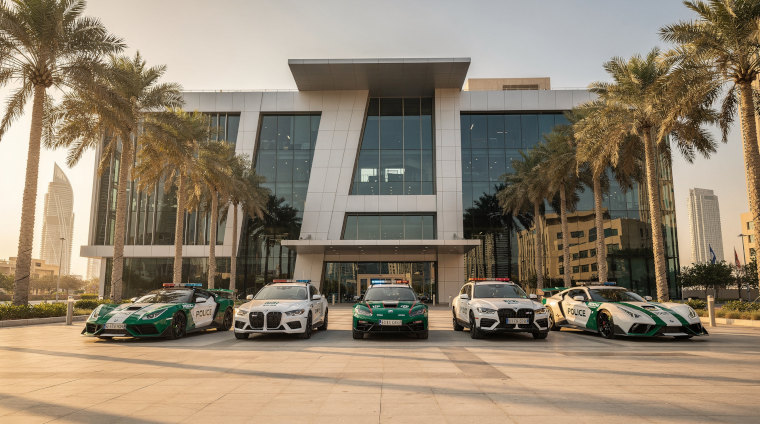
According to publicly available sources, Dubai Police Force has more than 15,000 officers. This is an impressive figure for a city with a population of around 3.5 million people — approximately one officer for every 230 residents. But it is not just about numbers. The level of technological capability of Dubai Police is unparalleled in the region.
The image was generated using AI technologies
If you were to search for examples of the world's most advanced law-enforcement agencies, Dubai Police Force would invariably appear among the first. The service actively uses:
facial recognition systems on streets and in public places;
artificial intelligence for crime prediction;
robotic police officers for patrolling shopping centres;
mobile applications for filing reports and paying fines online.
All of this makes Dubai Police one of the most modern law-enforcement bodies not just in the Middle East, but in the world.
In 2015, Dubai Police Force was ranked among the best employers in the UAE according to local ratings — news of this achievement was widely covered in regional media and confirmed the high level of training and motivation of its officers. Up-to-date news about the department's activities is regularly published on its official website.
How Dubai Police differs from what you are used to
If you are accustomed to the Russian or European model of policing, Dubai will surprise you. Officers there are generally polite, speak English and are focused on helping tourists. The service views foreign guests not as potential offenders, but as people who need support in an unfamiliar country.
At the same time, Dubai Police remains a strict organisation with clearly defined powers. The department's internal policy requires strict compliance with UAE law, and ignorance of local rules does not exempt anyone from responsibility. This is precisely why searching out information about local laws and norms in advance is very much in your own interests.
The more information you learn about the emirate's regulations in advance, the more comfortable your stay in the country will be.
What Dubai Police Drive: The Legendary Supercar Fleet
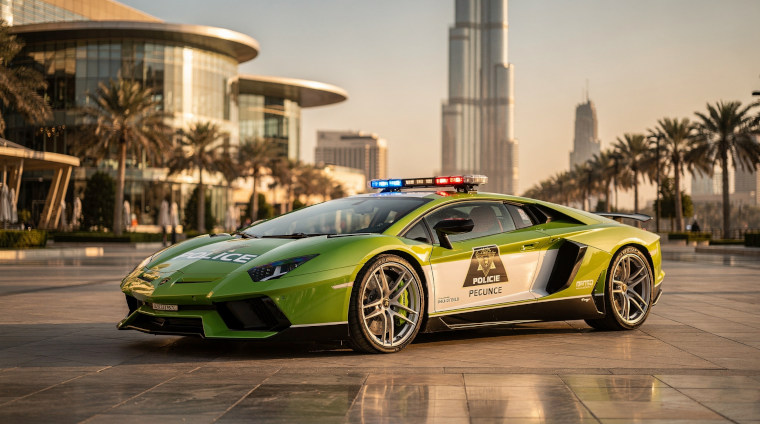
Imagine this: you are strolling along the JBR promenade, and a bright-green Lamborghini with the word "Police" on its side streaks past you. This is not a commercial shoot or a private collection — it is an ordinary working shift for Dubai Police.
The image was generated using AI technologies
The Dubai Police fleet has long become one of the city's main attractions, and there is a perfectly clear logic behind it.
Which supercars does Dubai Police have?
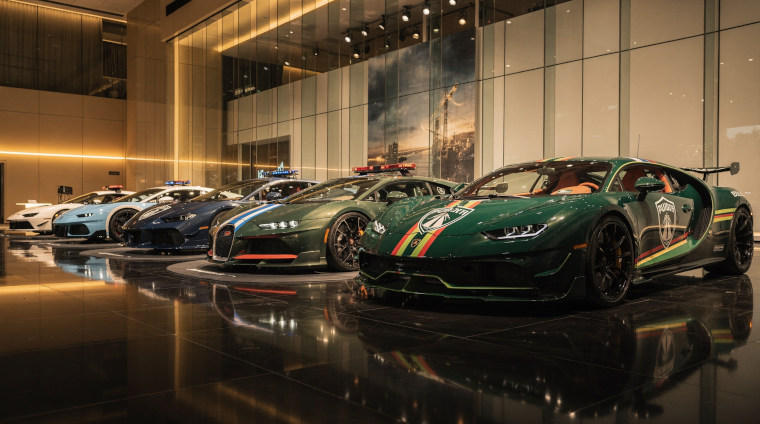
Dubai Police has been building its car collection for years, and today the fleet numbers several dozen supercars, which are regularly updated with new models. Here are the key specimens in the collection:
Bugatti Veyron — one of the fastest patrol cars in the world. Zero to 100 km/h in under 3 seconds, a top speed of over 400 km/h. Price: approximately $1.7 million.
Lamborghini Aventador — an Italian supercar producing 700 hp and a price tag starting at $400,000. It has become one of the fleet's defining symbols.
Ferrari FF — the first four-wheel-drive Ferrari in the brand's history, priced at approximately $300,000.
Bentley Continental GT — a luxurious British grand tourer that costs around $200,000.
McLaren MP4-12C — a British supercar with a carbon-fibre monocoque, priced at around $230,000.
Mercedes-Benz SLS AMG — a legendary German sports car with gull-wing doors, priced at $180,000.
Aston Martin One-77 — one of the rarest cars in the world, with only 77 units produced. Price: approximately $1.4 million.
Porsche 918 Spyder — a hybrid hypercar producing over 880 hp, priced at more than $800,000.
The combined value of these eight cars alone exceeds $5 million. And this is only part of a collection that continues to grow.
Why does the police need such cars?
The honest answer: not for high-speed chases. Dubai is one of the safest cities in the world, and high-speed pursuits are a rarity there. Dubai Police supercars serve an entirely different function.
First, they are an image tool. Dubai positions itself as a city of the future, a place where anything is possible. A Bugatti Veyron patrol car on the street tells a tourist more than any advertising campaign ever could: things work differently here; the level here is different.
Second, they engage with the tourist flow. The supercars are stationed precisely where the city's visitors are concentrated: at Dubai Mall, along the JBR promenade, on Palm Jumeirah. Tourists take photographs beside the police Lamborghinis and Ferraris, post the pictures on social media, and the city receives millions of free mentions worldwide.
Third, it is a signal to a wealthy audience. Dubai actively attracts affluent residents and investors. A police Aston Martin One-77 on the street is a message: we understand your language and your values.
Where can you see Dubai Police supercars
What Dubai Police drive is a question that is asked by many tourists even before they arrive. The answer is simple: look for the supercars wherever there are the most people and cameras.
Main patrolling locations:
Dubai Mall and Downtown Dubai — the city's most tourist-heavy district.
JBR (Jumeirah Beach Residence) — a popular promenade with restaurants and a beach.
Palm Jumeirah — the artificial island of hotels and villas.
Dubai Marina — a yacht marina with upscale restaurants.
Dubai Mall и Downtown Dubai — самый туристический район города.
JBR (Jumeirah Beach Residence) — популярная набережная с ресторанами и пляжем.
Palm Jumeirah — искусственный остров с отелями и виллами.
Dubai Marina — яхтенная марина с дорогими ресторанами.
The image was generated using AI technologies
On weekdays the supercars appear less frequently, but at weekends and on public holidays, they can be seen considerably more often. If you want a guaranteed chance to see the collection in person, visit the Dubai International Motor Show or the special exhibitions where the police traditionally put their entire fleet on display.
The fleet as part of the city's DNA
It is important to understand that Dubai Police's supercar fleet is not a whim or extravagance. It is a deliberate strategy by a city that is building its brand on contrasts and records. Dubai was the first city in the world to launch jetpack patrols, the first to deploy robotic police officers, and the first to assemble such a collection of supercars in a single fleet.
Every new car added to the collection is a news story that travels around the world's media. Every tourist photograph beside a police Ferrari is free advertising for Dubai.
So when you see a Lamborghini Aventador with flashing lights on the street, bear this in mind: what you are looking at is not merely a vehicle, but one of the most effective marketing tools of one of the most ambitious cities on the planet.
The Flying Police in Dubai: Tomorrow's Technology Today
If Dubai Police supercars inspire admiration, the flying police in Dubai is a genuine mind-bending phenomenon.
Imagine: traffic is at a complete standstill on Sheikh Zayed Road, while a police officer on a flying motorcycle simply lifts into the air and arrives at the scene of the incident within seconds. This is not a science-fiction film — it is a real project that Dubai Police launched back in 2017.
The Hoversurf Scorpion: what it is and how it works
Dubai Police did not choose a hoverbike by chance. The Russian company Hoversurf developed the Scorpion model specifically to meet the needs of urban security services. In essence, it is a hybrid of a motorbike and a quadcopter: the pilot sits astride the vehicle whilst four powerful rotors lift the whole structure into the air.
Technical specifications of the Hoversurf Scorpion:
maximum speed — approximately 70 km/h;
flight altitude — up to 5 metres above the ground;
operating time on a single battery charge — around 10–25 minutes, depending on the load;
control — either manually by the pilot or in autonomous mode without a rider.
The limited flight time remains the main technical challenge for now. However, engineers are actively working on increasing battery capacity, and each new generation of the device shows noticeable progress.
What tasks does the flying police in Dubai perform?
Dubai is a city of contrasts: ultra-modern skyscrapers sit alongside the narrow lanes of the old Deira district, while large-scale events draw hundreds of thousands of people. This is precisely where hoverbikes and drones prove indispensable.
Main use cases:
patrolling hard-to-reach areas — beaches, construction zones, densely built-up districts;
rapid response in traffic-congested conditions, when ground transport loses precious minutes;
crowd monitoring at large events — concerts, sporting matches, New Year celebrations;
initial aerial assessment of a situation before the main forces arrive.
Dubai Police also makes active use of drones for surveillance and patrolling. Unmanned aerial vehicles can hover over a designated area for hours, transmitting video in real time to the situation centre.
Connection with the Volocopter project and the Smart Dubai strategy
The flying police in Dubai is not an isolated experiment, but part of a large-scale urban ecosystem. Dubai is investing in the development of flying taxis based on the German Volocopter — an electric aerial vehicle designed to carry passengers without a pilot.
The technologies being tested in police projects, such as air traffic management, safety systems, and navigation in an urban environment, feed directly into the civilian aviation infrastructure.
All of this is part of the Smart Dubai strategy and the national Vision 2030 programme, whose goal is to make Dubai the most technologically advanced city on the planet. The police functions not merely as a law-enforcement body, but as a full participant in digital transformation.
Why this matters for tourist safety
For you as a tourist, this means one thing: the level of emergency response in Dubai is exceptionally high. Advanced surveillance systems, aerial patrolling, and integrated monitoring systems allow the police to reach the right place faster than you can even register that something has gone wrong.
The image was generated using AI technologies
Dubai invests in safety not for the sake of image — it is a real infrastructure that functions every single day.
Dubai Police Number and Emergency Service Contacts
Suppose you are walking through Dubai Mall and someone steals your bag. Or you witness a road accident on Sheikh Zayed Road. What do you do? The first step is knowing who to call. The good news: Dubai Police contacts are straightforward, and operators speak English, so the language barrier will not be an issue.
The main numbers to save right now
Add these four numbers to your our phone's contacts before you even board your flight — it will take a minute and could save you hours in a critical situation:
999 — emergency call to Dubai Police.
901 — non-emergency Dubai Police line (enquiries, complaints, consultations).
998 — ambulance.
997 — fire service.
All calls to these numbers are free from any phone, including foreign SIM cards. Roaming, a prepaid tourist card, a local number — it does not matter. You dial and you get through.
When to call 999 and when to call 901
This is an important distinction that many tourists are unaware of. The number 999 is for genuine emergencies: a crime is happening right now, there is a threat to life, immediate help is needed. The operator will connect you with the nearest unit within seconds.
The number 901 is Dubai Police's information and service line. You should call here if you need to report a minor offence, clarify the procedure for filing a report, find out the address of a police station, or get advice. Operators on both numbers speak English, so explaining your situation will not be difficult.
Alternative ways to contact Dubai Police
The telephone is not the only channel. Dubai Police is actively developing digital services, and for tourists this is very convenient:
Dubai Police mobile app — allows you to file a report, report an incident, track the status of your enquiry, and even pay a fine. Available on the App Store and Google Play.
Online chat on the official Dubai Police website (www.dubaipolice.gov.ae) — available around the clock, supports English.
Your nearest police station — if the situation is not an emergency but requires your personal presence.
Where police stations for tourists are located
If you need to visit Dubai Police in person, you can head to stations in the following tourist districts:
Deira — one of the city's oldest districts; the station serves tourists in the area of the Gold and Spice Souks.
Al Barsha — convenient for those staying near Mall of the Emirates.
Jumeirah — a station in the beachfront hotel zone.
Addresses and opening hours are best checked through the Dubai Police app or on the official website, as they are updated periodically.
A practical tip before your trip
Do one simple thing: open your phone and add the Dubai Police numbers — 999 and 901 — to your contacts right now. Save 998 and 997 alongside them. It will take two minutes, but in a stressful situation you will not be frantically trying to recall the numbers.
Download the Dubai Police app in advance — it works without a local SIM card via Wi-Fi.
Dubai is one of the safest cities in the world, and in all likelihood you will never need these numbers. But knowing them is simply common sense.
Interacting with Dubai Police: All You Need to Know
Dubai is one of the safest cities in the world, and much of the credit for that goes to a police force that works with precision, professionalism, and — importantly for tourists — a welcoming attitude. But "welcoming" does not mean "anything goes". UAE legislation is strict, and ignorance of the law does not exempt anyone from responsibility — this is a fundamental principle of the local legal system.
Always carry your documents
The first and most important rule: carry your documents with you at all times. For tourists this means their passport; for residents, their Emirates ID. Dubai Police have the right to check your identity at any time, and the absence of documents can create unnecessary complications even in the most innocent of situations.
If you are driving, add your driving licence and vehicle documents to your passport.
How to behave when speaking with an officer
Imagine: an officer has stopped you on the road or approached you in the street. Here is a simple set of guidelines:
Speak calmly and do not raise your voice, otherwise it will be perceived as disrespect and can make the situation worse.
Do not gesticulate aggressively or argue.
Answer questions clearly and to the point.
Do not photograph police officers without their permission — this is a violation that may be interpreted as provocation.
That last point is not merely advice — it is a warning. Offering a bribe in the UAE is a serious criminal offence. There is no such thing as "settling things on the spot" — it does not work and will result in far greater problems than the original fine.
Police officers in Dubai are generally well disposed towards tourists and are happy to help with directions, calling a taxi, or any other query. Many speak English, and in tourist areas you may encounter officers fluent in several languages.
Fines in Dubai: reason and amount
Dubai's laws may seem unusually strict to tourists, but there is logic behind them. Order is taken seriously there, and fines are real, not nominal.
Traffic violations are one of the most common expenses for tourist drivers:
Speeding — from 400 to 3,000 dirhams, depending on the degree of excess.
Running a red light — 1,000 dirhams.
Using a mobile phone whilst driving — 800 dirhams.
Not wearing a seatbelt — 400 dirhams.
But fines in Dubai are not limited to the road. Consuming alcohol in public places is prohibited; you may only drink in licensed establishments, such as restaurants, bars, and hotels. Appearing drunk in a street risks detention and a fine.
Indecent behaviour in public is another area of risk. Loud arguments, obscene language, and excessive displays of affection can all attract the attention of the police. The fine for obscene language starts at 250 dirhams.
Violating the dress code in religious sites — mosques and their surroundings — will also not go unnoticed. Bare shoulders, short shorts, and see-through clothing are inappropriate there. Whether you receive a warning or a fine depends on the situation, but the reputational damage is guaranteed.
How to pay a fine
The fine payment system in Dubai is convenient, with no queuing or paperwork. You can pay:
Via the Dubai Police mobile app (available for iOS and Android).
At police stations or through dedicated payment terminals.
Traffic fines are linked to the vehicle's number plate, so you can check them at any time through the app by simply entering the vehicle's details.
The main principle: respect works both ways
Dubai Police is an institution that takes pride in its reputation and values it highly. Respectful conduct on your part is almost always met with the same in return.
Tourists who behave appropriately, are aware of the basic restrictions, and do not attempt to circumvent the rules generally have no issues whatsoever with UAE law. Dubai is made for guests to feel comfortable, and the police there is more of a helper than a threat.
Frequently Asked Questions
What is the phone number for Dubai Police?
The Dubai Police number is 999, which operates around the clock and calling it is free from any phone. Operators speak English, so the language barrier will not be a problem. For non-emergency situations, use the number 901 — this is Dubai Police's helpline for enquiries and consultations.
What cars does Dubai Police drive?
Dubai Police drive some of the most impressive cars in the world: Bugatti Veyron, Lamborghini Aventador, Ferrari FF, Aston Martin One-77, and Bentley Continental GT. These are not merely display pieces — the supercars patrol tourist districts and take part in real operations. In addition to the supercars, Dubai Police also drives standard Chevrolet Camaros and Toyota Land Cruisers for everyday duties.
Does the flying police in Dubai actually exist?
Yes, the flying police in Dubai is a reality, not an urban legend. Since 2017, the service has operated single-seat flying motorcycles — the Hoversurf Scorpion — capable of reaching speeds of up to 70 km/h and ascending to a height of 5 metres.
Dubai Police is also actively testing other aircraft as part of the smart city programme. The aim is to reduce response times in high-traffic areas to a minimum.
Can you take photos with Dubai Police cars?
Yes, the police supercars are specifically positioned in tourist zones — outside Dubai Mall, along the JBR promenade, and at other popular locations — for exactly this purpose. Photographing the vehicles is permitted, and officers are generally welcoming about it.
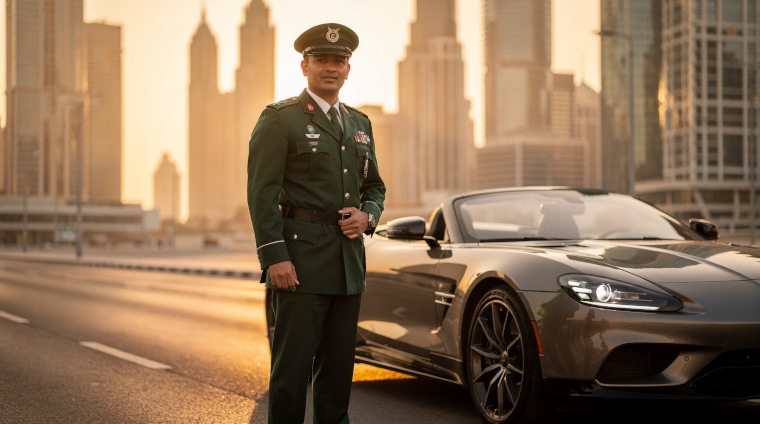
The image was generated using AI technologies
However, photographing the officers themselves without their consent is not advisable — this may be treated as a violation.
What should you do if Dubai Police stop you?
Stay calm and present your documents immediately — your passport or driving licence. Speak politely, do not raise your voice, and do not argue with the officer on the spot — this is an important principle when dealing with UAE police.
If you do not understand what you are being charged with, politely ask for an explanation in English. You have the right to request an interpreter and to contact your country's consulate.
What fines does Dubai Police issue to tourists?
The most common fines concern traffic violations, consuming alcohol in public places, and inappropriate behaviour. The fine for speeding starts at 300 dirhams, and for a public display of affection, at 1,000 dirhams.
UAE law applies to everyone without exception, including tourists, so ignorance of the rules does not exempt anyone from responsibility.
Article header image was generated using AI technologies
Features of the Dubai Festival City district. Daily life in Dubai Festival City. Housing in Dubai Festival City. Shopping and entertainment in Dubai Festival City. Transport accessibility of Dubai Fes...
What attracts tourists to shopping in Abu Dhabi? What to buy in Abu Dhabi. 10 best shopping centres in Abu Dhabi. What to pay attention to while shopping in Abu Dhabi. Frequently asked questions about...
This article discusses which emirates are better and the characteristics of the UAE regions. While tourists are interested in hotels, beaches and entertainment infrastructure, other factors must be co...
At first glance, schools in Dubai differ little from those in other countries: similar large buildings, classrooms, and uniforms. However, the education process itself is structured slightly different...
Main features of Sharjah City Centre. What’s for sale at Sharjah City Centre? Entertainment for children at Sharjah City Centre. Restaurants at Sharjah City Centre. Cultural events at Sharjah City Cen...
Benefits of starting a company in Dubai. Nuances of starting a company in Dubai. What is required to start a company in Dubai? How to start a company in Dubai as a foreigner in 2026? Relocation of exi...
Significance of import and export in the UAE. Main items of UAE export and import. Specifics of UAE import and export with Russia. Rules for export from the UAE to Russia. Rules for import from Russia...
The best golf clubs in Dubai. Rooftop golf in Dubai — unique venues. Practical tips for playing golf in Dubai. Golf tourism in Dubai. Frequently asked questions.



 The image was generated using AI technologies

 The image was generated using AI technologies

 The image was generated using AI technologies

 The image was generated using AI technologies


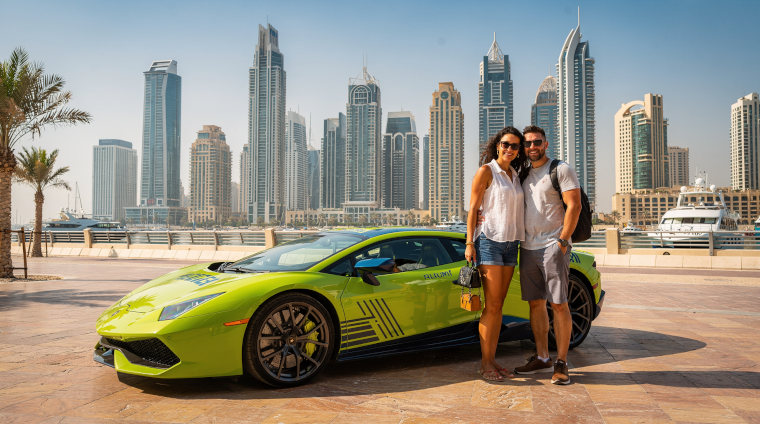 The image was generated using AI technologies