Dubai postcode: what to enter instead of a postcode in the UAE
Save the article:
Filling in a registration form and stuck on the “postcode” field? It's a familiar situation: you've moved to Dubai, you're applying for a bank card or trying to order something from an overseas website, and the system asks for a Dubai postcode that simply doesn't exist.
This isn't a website error or an oversight on your part — the United Arab Emirates doesn't use the classic postcode system that people in Russia, Europe or America are used to. Instead, the country works on a different addressing logic, and understanding it is easier than it first appears.
What will you get from reading this article? You'll find out which values forms actually accept instead of a postcode, how the P.O. Box system works in Dubai and the UAE as a whole, and what to write in the address fields so that your order arrives, your card is issued, and your documents are accepted without unnecessary questions. We'll look at specific examples of filling in forms — from everyday delivery websites to customs waybills — so that you're left with a clear plan of action for every situation.
How the Postal System Works in the UAE
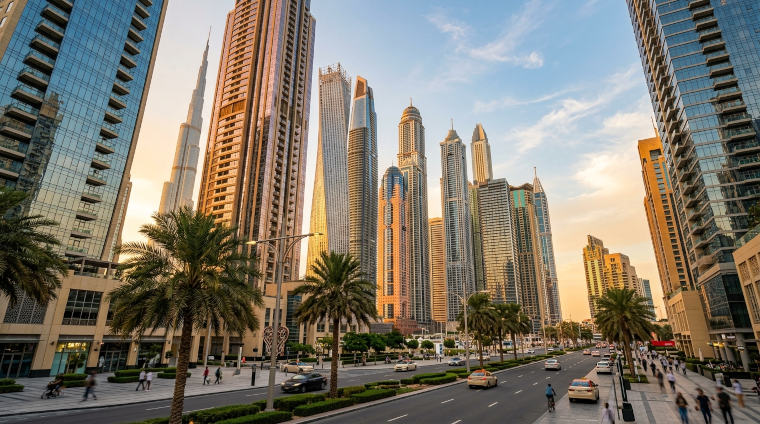
The United Arab Emirates has built an addressing system that works without the familiar postcode, yet still reliably delivers correspondence, parcels and documents across the entire country.
The image was generated using AI technologies
Understanding the logic of the UAE is simple once you set aside your usual expectations and look at what an address actually consists of: emirate, city, district, building number and P.O. Box. A UAE postcode, as a separate national system, simply doesn't exist, and this is the official norm rather than a temporary inconvenience.
Why Dubai doesn't have a standard postcode
Dubai postal code is a search query typed in by thousands of people, but they don't find a result for an objective reason: the city grew too quickly and too chaotically for a classic postcode system to be introduced in time.
Older districts developed without a unified street-numbering system, new neighbourhoods were built up at different times by different developers, and tying all of this to a single postal code turned out to be impractical. It was simpler to scale up the already-working P.O. Box system, which doesn't depend on the precise geometry of the streets.
The same picture can be seen in all the emirates — Abu Dhabi, Sharjah, Ajman and Ras Al Khaimah. There's no unified postal system with postcodes, either at the city level or nationwide. A similar situation is typical of the neighbouring Gulf states too: Saudi Arabia introduced postcodes relatively recently, while Qatar and Bahrain, like the UAE, manage entirely without zip codes, relying instead on P.O. Box numbers and a written description of the address.
This administrative approach to addressing developed historically and is still considered perfectly workable.
Emirates Post is the state operator responsible for delivering mail and parcels across the whole country. It operates without a postcode: letters and shipments are routed via the P.O. Box, the name of the company, the district and the emirate. This sets the UAE apart from most countries, where the postal service sorts correspondence by postcode.
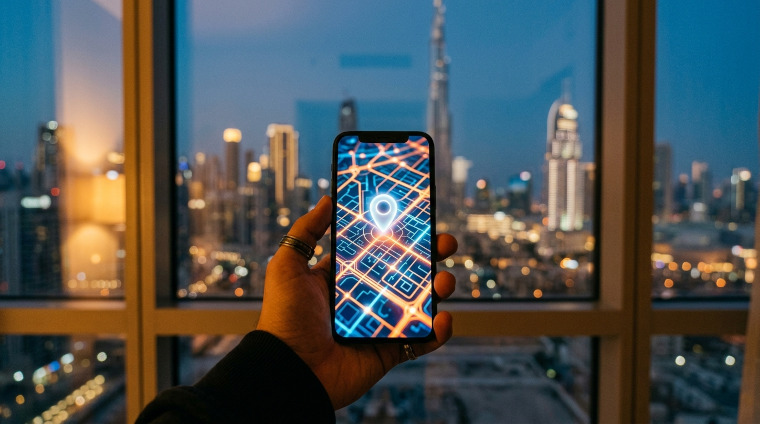
To compensate for the lack of street numbering, the Dubai authorities created the Makani system — a unique 10-digit number assigned to every building in the city. Makani precisely records the geographical coordinates of the building and is used by navigation services, couriers and emergency services instead of a traditional zip code.
The image was generated using AI technologies
Finding your number is easy — you just need to do a quick search using one of the available tools:
the Dubai Now app or the standalone Makani app;
the official Dubai Municipality address-lookup website;
the sign at the entrance to the building — the number is often displayed on the façade.
You should provide your Makani number when ordering home delivery, booking a taxi or a courier, and for certain government services that require the precise location of a building. For a P.O. Box, bank forms or international waybills, this number usually isn't required — a different address logic applies there.
In the sections that follow, we'll look at some common questions: exactly what to enter in the postcode field on websites, how to set up and use a P.O. Box, and which informal codes are used for emirates and districts when dealing with logistics and legal documents.
What to Enter Instead of a Postcode When Filling in Forms
When a form on a foreign website asks for a "Dubai Zip code", there are four workable approaches: leave the field empty if the system allows it; enter 00000; provide a district code; use a P.O. Box number. There's no single universally correct answer — the choice depends on who's collecting the form: an online shop, a bank or a government service. Let's look at each option in detail, starting with the one most commonly used.
The value 00000 and other commonly used options
Postal code 00000 has become an unofficial standard for Dubai simply because it's the easiest way to bypass form validation requiring a numeric input.
Many websites, designed without the specifics of the UAE in mind, won't let an application proceed if the postcode field is empty, and 00000 solves this technical problem in a second.
But this approach does carry risks. The form may reject the value if it is configured to validate the actual index range for a specific country. A parcel sent with 00000 sometimes gets held up at customs or at a logistics centre, because the sorting system doesn't know where to route a shipment with such a code. This isn't a critical problem, but it does add a day or two to the delivery time.
Besides 00000, there are other values that a form will sometimes accept:
000000 — a six-digit format for websites with a longer field;
DXB — the letter code for Dubai's airport, which some systems treat as an informal identifier for the city;
an emirate code — for instance, an arbitrary combination that users find by trial and error on a specific website.
Before entering any of these values, it's worth checking whether the website has a separate field for a P.O. Box or an order comment — it's useful to repeat your real address there.
Examples of filling in an address on overseas websites
Let's look at how to fill in an address form when ordering clothes or electronics from an overseas website. In the “city” field, enter “Dubai”; in the “state” or “emirate” field, also enter “Dubai”, since in the UAE's addressing system the emirate often duplicates the name of the city.
In the “street address” field, it makes sense to give the building number, the name of the district and, if you have one, the Makani number — this will help the courier find the delivery point within the country. In the “postal address” field, if it's separate from the “zip code” field, you can enter the P.O. Box number.
Example for a clothing online shop: city — Dubai, state — Dubai, street address — Building 12, Al Barsha 1, Makani 12345 67890, zip code — 00000.
Example for registering on an overseas platform with a more flexible form: if the “postal code” field is optional, it's best to leave it empty and give the full address, including the P.O. Box, in the comment field on the application.
Example for a parcel delivered by a courier service: the “street address” field should list the P.O. Box number and the name of the district; as for the Dubai postal code, most international carriers accept either an empty value or 00000 without any impact on routing.
P.O. Box as an Alternative to a Postcode
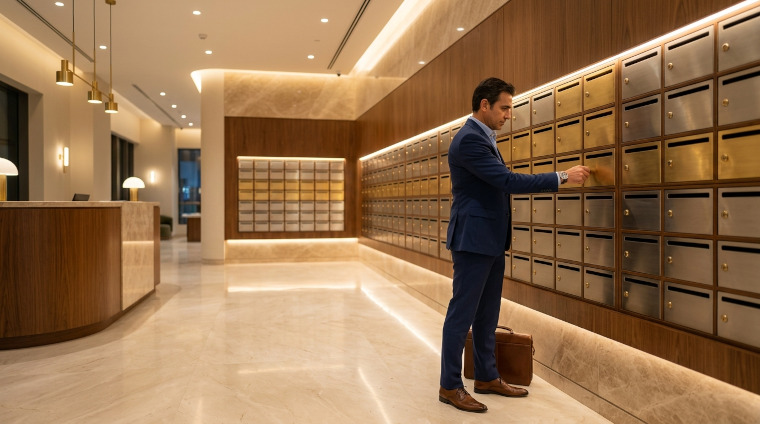
Dubai post isn't physically delivered to homes and offices — postmen in the familiar sense simply don't operate in the country. This means the only reliable way to receive letters, bills, bank cards and notifications from government bodies is to set up your own P.O. Box.
The abbreviation stands for post office box — a rented box at a post office to which all correspondence addressed to the owner is delivered.
The image was generated using AI technologies
The P.O. Box number is given in the address in place of the usual postcode line and acts as a permanent identifier for the mail-collection point. Almost everyone uses this system: private individuals register a personal box for bank documents and parcels, while companies register a corporate one, without which it's impossible to obtain visas for staff, official correspondence with government bodies, or legally significant mail.
For a business, having an active P.O. Box isn't optional — it's a mandatory condition of operating: the postal address with the box number is stated in contracts, on letterheads, in bank details and on the trade licence.
How to rent a P.O. Box in Dubai
Setting up a box is done through Emirates Post — the state operator that manages the entire network of post offices in the country. The process is straightforward and takes just a few steps.
Choose the nearest post office — the branch where the box will physically be located and where you'll need to go to collect your mail.
Submit an application — this can be done online via the Emirates Post website or in person at the branch, by filling in a standard rental form.
Prepare your documents: private individuals need a passport and an Emirates ID; companies need a trade licence, the passport of the authorised person and the company stamp.
Pay the rental fee — rates depend on the size of the box and the length of the contract; setting it up usually takes between one and three working days.
The rental cost varies depending on the emirate and the class of branch, but on average an annual subscription for a standard box is a reasonable amount, comparable to a company's other utility costs. A practical tip: if the box is only needed for personal letters and parcels, a basic personal P.O. Box is enough.
If, however, the post relates to business — visas, bank statements, legal correspondence — it's worth setting up a corporate box in the company's name from the outset, rather than a personal one, to avoid confusion when staff changes occur.
The difference between a P.O. Box and a postcode
A postal code, or zip code, is a geographical code assigned to an area: a street, a district or an entire city. A postcode doesn't depend on a particular person or company; it exists regardless of who lives at that address. A P.O. Box works on an entirely different principle: it's the number of a specific rented box at a specific post office, belonging to a single owner.
Functionally, a P.O. Box doesn't replace a postcode, because it doesn't describe an area, but it performs a similar task — pointing to the location a letter needs to be delivered to. In the absence of street-based postal coding, it's the only reliable point of reference for Dubai post and other cities in the UAE.
The key difference is easiest to sum up in a short comparison:
Parameter
Postal code (postcode)
P.O. Box
What it denotes
an area, district or city
a specific rented box
Linked to
geography
the owner
Who assigns it
the country's postal service
the post office, upon rental
When filling in international forms, it's important not to confuse these two concepts: if a website asks for a postal code and you only have a P.O. Box number, you shouldn't enter it in the “postcode” field — these are different categories of data, and mixing them up sometimes leads to a validation error or a delivery delay.
Area and Emirate Codes in the UAE
Dubai code and the postcodes of neighbouring emirates work on the same logic: instead of being tied to a street or a house, a P.O. Box at a specific post office is used, and informal district designations appear only within logistics and addressing systems, not as an official UAE postcode.
The image was generated using AI technologies
If a conventional system operated in the UAE, every neighbourhood of Dubai would have its own five-digit code, as in Moscow or New York. In the United Arab Emirates, this role is partly taken on by P.O. Box ranges and internal district codes, which are useful to know when filling in logistics documents, contracts and address forms.
Codes for popular Dubai districts (Deira, Marina, Downtown)
Deira, Dubai Marina, Downtown Dubai near the Burj Khalifa, Al Barsha, Jumeirah and Business Bay are the districts most often given in addresses for deliveries, business registration and document processing.
They have no official postcode, but every major post office has its own range of P.O. Box numbers, and buildings have a Makani code that pinpoints their exact location within the district. It's a convenient combination: the district names the area, while the P.O. Box and Makani indicate the exact delivery point.
In logistics systems and address forms, companies often use internal informal district codes to sort orders by delivery zone. Here's what this kind of data typically looks like:
District
Informal code
P.O. Box range (example)
Deira
DEI
1000–5999
Dubai Marina
MAR
50000–54999
Downtown Dubai
DWT
9000–9999
Al Barsha
BAR
27000–27999
Business Bay
BZB
65000–65999
These codes aren't a state standard; they're created by logistics companies or developers themselves for internal record-keeping. When filling in official documents, you should go by the actual P.O. Box number of the branch the address is linked to, rather than the informal district code from a courier company's table.
Postcodes in other emirates: Abu Dhabi, Sharjah, Ajman
The absence of a classic postcode applies equally across all the emirates: Abu Dhabi, Sharjah, Ajman, Fujairah, Ras Al Khaimah and Umm Al Quwain all work on the same principle as Dubai. The only difference lies in the P.O. Box ranges and the names of the local post offices serving specific districts in each emirate.
In terms of approximate ranges, the picture looks like this:
Abu Dhabi — P.O. Box numbers are usually within the range of 1–150,000, since it's the largest emirate with the greatest number of branches;
Sharjah — ranges are usually from 1,000 to 90,000, with a dense network of branches in the central districts;
Ajman — a compact emirate, with P.O. Box numbers mostly within the range of 1–20,000;
Fujairah, Ras Al Khaimah and Umm Al Quwain — smaller territories, where box numbers rarely exceed 10,000–15,000.
All these ranges are approximate and may change as branches grow in number, but the general principle stays the same. The system is managed by a single state operator, Emirates Post, which brings together the post offices of all seven emirates into one network.
That's why, when dealing with addresses across the whole country — whether the UAE as a whole or one small emirate — the logic for filling in an address stays the same: the name of the emirate, the city, the district, the P.O. Box number. A UAE postcode as a single national code isn't needed in this system — the combination of emirate, branch and box number identifies the location unambiguously.
Delivery of Parcels and Documents to Dubai
International delivery to Dubai works reliably even without a postcode — courier services adapted to the local addressing system long ago and know which details to rely on instead of a zip code. FedEx, DHL and Aramex use a combination of the P.O. Box, the Makani number and the name of the district, and confirm any missing details with the recipient by phone.
This isn't something individual companies have improvised — it's standard practice across the entire UAE market, so there's no need to worry about your parcel's safety; you just need to fill in the address fields correctly.
Specifics of customs and postal shipments
When crossing the UAE customs border, a parcel is checked not by postcode but by a full set of details: the recipient's name, emirate, district, P.O. Box number and, essentially, a phone number. Customs services and Dubai post rely precisely on this set of information, because there's simply no single area code there — instead, a written description of the address works together with the recipient's contact details.
The accompanying documents for international shipments must include the exact name of the receiving company or individual, a full postal address and a contact phone number in international format. If the cargo documents show only a city with no district or P.O. Box, the cargo will very likely be held up at a logistics centre — a member of staff will have to manually confirm the route, which adds an extra day or two of waiting.
The practical advice is simple: always give the recipient's phone number and as detailed an address as possible, even if the form doesn't mark these fields as mandatory. The courier needs to be able to call and confirm the collection point, especially if the building doesn't have conventional street numbering. The more detailed the address, the lower the chance that the parcel gets held up at customs or ends up in the wrong place.
How to fill in the address correctly when ordering from abroad
When placing an order on an overseas website with delivery to Dubai via FedEx, DHL or Aramex, it's recommended to follow this sequence of details:
the recipient's first and last name in Latin script;
the name of the district and building, and the Makani number if you have one;
the P.O. Box number, if the parcel is being sent by post rather than by courier to the door;
city and emirate — both fields are usually filled in as “Dubai”;
a phone number in the +971 country-code format;
the “Dubai postal code” field — if it's mandatory, enter 00000, but be sure to repeat the full address in the order comment as well.
For documents and business correspondence, the situation is a little stricter: banks, government bodies and law firms require the company's P.O. Box, not a personal courier-delivery address. If you're sending official paperwork, confirm the exact P.O. Box number and the name of the post office with the recipient — this will remove the risk of the letter getting stuck in sorting.
What to do if a parcel is delayed
If a shipment gets stuck at the customs-clearance stage, the first thing to do is check the tracking number on the courier company's website — the reason for the delay is usually indicated there. Most often the problem lies in an incomplete address: a missing phone number, an unspecified district, or a mixed-up P.O. Box number.
The image was generated using AI technologies
In this case the logistics company will contact the recipient to confirm the details, but the process will be faster if you call support in advance and give them the current postal address. The international status of a shipment can always be tracked online, and this is the quickest way to find out at what stage the parcel is stuck.
Frequently Asked Questions
What is the postcode for Dubai?
Dubai doesn't have a postcode in the conventional sense, and this is the official norm rather than a technical error on the part of a website or bank.
Instead of a zip code, the addressing system is built on a combination of the emirate, district, building and the P.O. Box of a specific post office. So the Dubai postcode that people search for online simply doesn't exist, either as digits or as a letter code. Any form that requires this field is built on a generic global template and doesn't take the specifics of the UAE into account.
Can 00000 be entered as the UAE postcode?
Yes, 00000 has become an unofficial standard and is accepted by most overseas websites when ordering goods for delivery to Dubai. This helps get past form validation if the “postcode” field is mandatory and won't accept an empty value.
It's a workable option for online shops, but it isn't suitable for bank documents and legal paperwork — a P.O. Box is needed there. If in doubt, repeat the full address in the order comment so the courier doesn't get lost.
A P.O. Box is a rented mailbox at a specific Emirates Post branch, to which all of the owner's correspondence is delivered. It performs the function of a Dubai postal code, because doorstep delivery by postmen isn't practised in the country at all.
Private individuals set up a mailbox for their personal letters and parcels, and companies set one up for bank documents, staff visas and official correspondence. Without an active P.O. Box, many government and financial services simply won't accept an application for processing documents.
How can I find out the district code in Dubai for delivery?
There's no official district postcode as part of a UAE postcode, but the Makani system is used for navigation and precise delivery — a unique building number linked to its coordinates. You can find your number through the Makani app, the Dubai Now service, or on the sign at the entrance to your building.
Within logistics companies' own systems, informal letter codes for districts do appear, but this is an internal postal-sorting tool rather than a state-level Dubai postal code. When filling in official forms, go by the real address: district, building and P.O. Box number, and give the Makani number as additional information for the courier.
Article header image was generated using AI technologies
Population density of Dubai in 2025. Dubai’s Demographic Structure. Key growth factors of Dubai’s population. Specifics of life of the native citizens of the UAE and Dubai in particular. Frequently As...
General information about alcohol consumption rules in Dubai. Alcohol-related fines in Dubai. Places where you can buy alcohol in Dubai. Popular restaurants and nightclubs in Dubai licensed to sell al...
Advantages of working in the UAE. In-demand professions for work in the UAE. Visa requirements for work in the UAE. Life in the UAE for expats. Frequently asked questions about work in the UAE.
Main features of Mohammed Bin Rashid City. Infrastructure of Mohammed Bin Rashid City. Housing in Mohammed Bin Rashid City. Transport accessibility of Mohammed Bin Rashid City. Frequently asked questi...
Specifics of marriage between non-Muslims in the UAE. Marriage according to Sharia law. Legal requirements for those getting married in the UAE. What documents are needed to get married in the UAE? Ho...
Nuances of living with children in Dubai. Advantages and disadvantages of relocating to Dubai with children. Requirements for relocation to Dubai. Expenses related to relocation to Dubai. Best areas f...



 The image was generated using AI technologies

 The image was generated using AI technologies

 The image was generated using AI technologies

 The image was generated using AI technologies

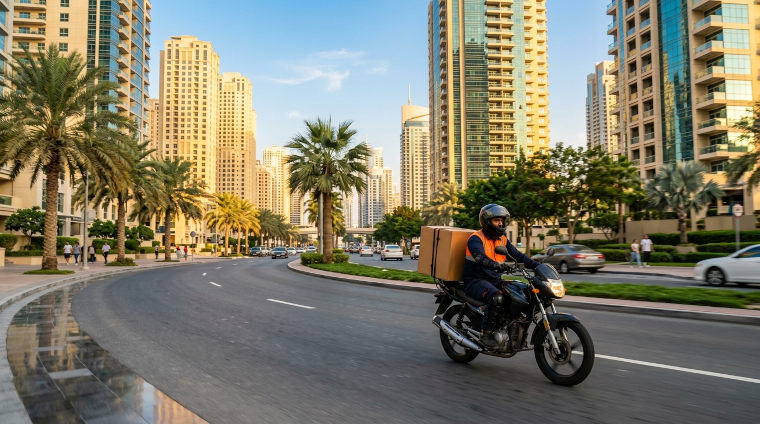 The image was generated using AI technologies