The UAE and Saudi Arabia: The Difference Between the Countries
Save the article:
What problem have you encountered? You are looking at a map of the Arabian Peninsula, you see two names — the UAE and Saudi Arabia — and you realise that you cannot explain how they differ from one another. Both countries are located on the shores of the Persian Gulf, both are rich in oil, both are Muslim countries of the Middle East. But this is precisely where the similarities end and the differences begin — differences that fundamentally change everything: from whether you can bring a bottle of wine with you, to how easy it is for a foreigner to find work.
What will you gain from reading this? In this article, we examine the UAE and Saudi Arabia, and the difference between them — honestly, without unnecessary complexity and with practical value for everyone. Tourists will understand where it is more comfortable to holiday and what to realistically expect from each country. Those considering relocation or employment will gain a clear comparison of working conditions, quality of life and the rights of expatriates in the United Arab Emirates and the Kingdom of Saudi Arabia. Students and journalists will find structured material that helps to clarify the political, cultural and economic differences between the two countries. The UAE and Saudi Arabia: the difference between is not just geography, as these are two different worlds, each of which is worth understanding before choosing where to go.
UAE and Saudi Arabia: What They Have in Common and Their Key Differences
Imagine being asked to explain the difference between two neighbouring countries on the Arabian Peninsula — and realising that they may look alike on the surface, but upon closer inspection are structured in entirely different ways. This is precisely the situation with the UAE and Saudi Arabia. The difference between them is felt almost from the very first hours of arriving in either country.
Who is who: a brief portrait of each country
The Kingdom of Saudi Arabia is the largest country on the Arabian Peninsula. Its capital is Riyadh, and its form of government is an absolute monarchy, in which the king wields absolute power. The backbone of the economy is oil exports, which have shaped the country's development for decades.
Today, Saudi Arabia is actively changing: the Vision 2030 reform, launched by Crown Prince Mohammed bin Salman, is aimed at diversifying the economy and gradually opening the country to tourists and investors.
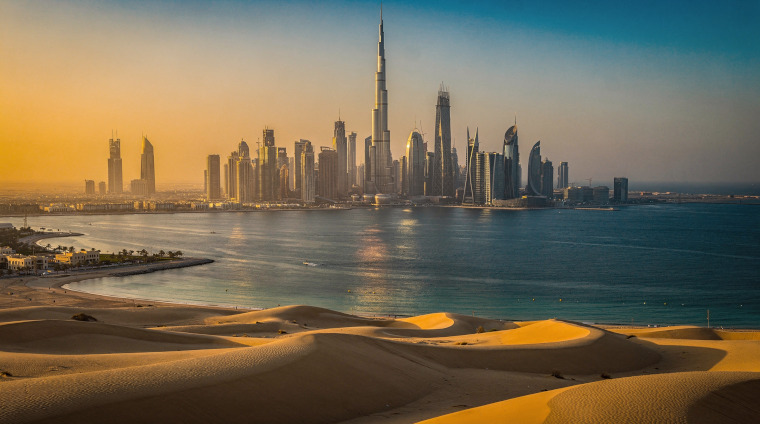
The United Arab Emirates is a federation of seven emirates, each with its own ruler. The capital is Abu Dhabi, but the most well-known city in the Arab world and beyond remains Dubai.
The image was generated using AI technologies
The UAE has long since become a financial and tourist hub: the country receives tens of millions of tourists each year and is among the most open countries in the region.
What the two countries have in common
Before examining the UAE and Saudi Arabia, and the difference between them, it is worth noting what they share. Both countries:
are located on the Arabian Peninsula and are among the countries of the Persian Gulf;
are Muslim countries, where Islam defines culture, laws and everyday life;
are governed by monarchies;
use Arabic as their official language;
possess significant oil reserves and a high level of GDP per capita.
This is an important context: despite all their differences, both countries share common values and a regional identity.
Key differences: a comparative table
This is where things get interesting. The difference between the UAE and Saudi Arabia is immediately apparent across several key parameters:
Parameter
UAE
Saudi Arabia
Area
approximately 84,000 km²
approximately 2,150,000 km²
Population
approximately 10 million
approximately 36 million
Form of government
federation of emirates
absolute monarchy
Capital
Abu Dhabi
Riyadh
Openness to tourists
high
moderate, increasing since 2019
Level of conservatism
moderate
traditionally high
Alcohol
permitted in hotels and restaurants
prohibited
What to note at first glance
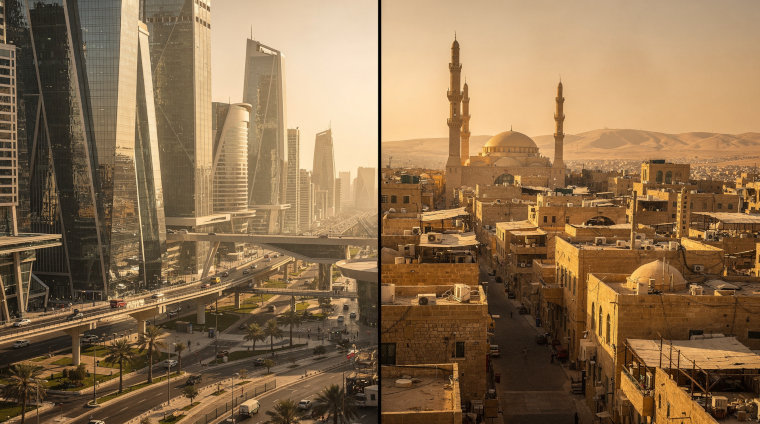
If you are a tourist or considering relocation, the difference is felt almost immediately. In the UAE, a foreigner feels at home: international infrastructure, a multilingual environment and relatively liberal behavioural norms in public places. Saudi Arabia offers a different experience — more authentic, deeply rooted in tradition, yet rapidly changing thanks to Vision 2030.
Both countries deserve attention, but for different reasons. We shall examine each aspect in greater detail below.
Culture, Laws and Way of Life: What are the Differences
Two Muslim countries, two neighbours on the Peninsula, yet the cultural distance between them is far greater than it appears on a map. The United Arab Emirates and Saudi Arabia have chosen different paths of development, and this is reflected in virtually every detail of daily life: in what you can wear, drink, say aloud and do without consequence.
Dress code: modesty everywhere, but different rules
In Saudi Arabia, following the 2019 reform, women are no longer required to wear the abaya — the traditional black full-length garment. This is an important change that many female tourists are unaware of. Nevertheless, clothing must be modest: covered shoulders, covered knees, no deep necklines.
In the United Arab Emirates, the rules are more relaxed in tourist areas. On a Dubai beach or in a shopping centre, you will see people dressed in all manner of ways. However, in mosques, government institutions and traditional neighbourhoods, only modest dress is appropriate.
The image was generated using AI technologies
Practical clothing tips:
In both countries, wear clothing that covers the shoulders and knees in public places.
In Saudi Arabia, avoid tight-fitting clothes and sheer fabrics.
In the UAE, a swimsuit on the beach is acceptable, but not in shopping centres.
Men in shorts above the knee would do well to refrain from visiting religious sites.
Alcohol: complete prohibition versus licensed freedom
This is perhaps the most tangible difference for tourists. In Saudi Arabia, alcohol is prohibited entirely — with no exceptions, no tourist concessions, no "only in the hotel." Bringing alcohol into the country is also a violation of the law.
In the United Arab Emirates, the situation is fundamentally different. Alcohol is permitted in licensed establishments — restaurants, bars and hotels. In Dubai and Abu Dhabi, this has become part of the tourist infrastructure. It is important to remember, however, that drinking in public places or appearing intoxicated in the street remains a violation of the law.
Women's rights: reforms are under way, but at different speeds
Saudi Arabia has made notable progress in recent years. Women have gained the right to drive (since 2018), to attend stadiums, and to open a business without the permission of a male guardian. The guardianship system (mahram) has been substantially weakened, though it has not been abolished entirely.
In the United Arab Emirates, women — both local and foreign — have long worked in a wide variety of fields, driven cars and lived independently. For female expatriates, this is one of the safest and most comfortable countries in the region.
Religious rules and Ramadan
Both countries are Muslim, and the month of Ramadan is observed strictly. However, the degree of public enforcement differs.
In Saudi Arabia during Ramadan, eating, drinking and smoking in public places during daylight hours is prohibited for everyone, including tourists. Music in public spaces is restricted. In the United Arab Emirates, the rules are similar, but the tourist infrastructure has adapted: restaurants operate behind drawn curtains, and hotels serve guests without restrictions.
Laws for tourists: what is strictly prohibited
Some prohibitions are the same in both countries; others are specific to each.
Prohibited in both countries:
Narcotics — criminal liability, including for transit.
Criticism of the ruling families and state authorities.
Public displays of affection (kissing, embracing) — a fine or deportation.
Photographing military installations, government buildings or people without permission.
Additionally in Saudi Arabia:
Any alcohol is prohibited.
Unmarried couples sharing a hotel room formally violates the law (regulation is relaxed, but the risk remains).
Public practice of non-Muslim religions is restricted.
Additionally in the United Arab Emirates:
VPNs formally require registration; use for unlawful purposes is a violation.
Social media posts that insult the country or its residents may result in arrest.
The key piece of advice before travelling
Both countries are conservative by the standards of a Western tourist, but in different ways. The UAE is a more open and internationally adapted environment. Saudi Arabia is changing quickly, but remains stricter.
The image was generated using AI technologies
Research the current rules before travelling, as the laws are updated regularly, and something that was prohibited three years ago may be permitted today.
Economy, Business and Employment Opportunities
When it comes to money, work and business, Saudi Arabia and the United Arab Emirates are two entirely different worlds. One country is only beginning its transformation; the other has already come a long way along that path. Understanding this difference will help you make the right choice, whether you are looking for work, setting up a company or making an investment.
Saudi Arabia: an oil giant on the path to change
The Saudi Arabian economy is the largest in the Arab world, with a GDP of approximately $1.1 trillion. Historically, it has been sustained by oil exports, which still account for a significant share of government revenues.
Since 2016, however, the country has been actively implementing Vision 2030 — a large-scale economic diversification programme aimed at reducing dependence on hydrocarbons and developing tourism, technology, entertainment and manufacturing.
Under this programme, ambitious projects have been launched: the futuristic city of NEOM, valued at over $500 billion; the Red Sea Project resort; and various industrial zones and technology parks. The country is actively attracting foreign investors, simplifying regulation and opening up markets that were closed to foreign capital as recently as ten years ago.
UAE: a diversified economy and business without barriers
The United Arab Emirates completed the process of economic diversification earlier and to a greater extent. Today, oil accounts for only around 30% of the country's GDP; the remainder comes from trade, finance, tourism, logistics and real estate. Dubai has become a regional trade hub and financial centre comparable in significance to Singapore and Hong Kong.
The principal instrument for business in the UAE is free economic zones, or freezones. There are more than 40 of them in the country: DMCC, DIFC, Dubai Internet City and others. In a freezone, a foreigner can own a company in its entirety, pay no corporate tax (in most cases) and freely repatriate profits. This is precisely why thousands of international companies choose the UAE as their base for operating in the Middle East.
Taxes and salaries: key differences
Both countries are attractive from a taxation perspective, as neither levies personal income tax on individuals. However, there are important differences.
Key economic indicators:
VAT in Saudi Arabia stands at 15%; in the UAE it is 5%.
Corporate tax in the UAE was introduced in 2023 and stands at 9% (for companies with profits exceeding 375,000 dirhams); in Saudi Arabia it is 20% for foreign companies.
The average expat salary in the UAE ranges from $5,000 to $15,000 per month, depending on the field and position; the average expat salary in Saudi Arabia ranges from $4,000 to $12,000, with accommodation and medical insurance often provided in addition.
GDP per capita in the UAE is approximately $49,000; in Saudi Arabia it is approximately $32,000.
The labour market: who is in demand and on what terms
In the UAE expatriates make up the majority of the workforce; their share exceeds 88%. In Saudi Arabia their share is around 38%, though the government is actively pursuing a policy of "Saudisation" — replacing foreign specialists with local personnel.
The most in-demand specialists in the UAE are those in IT and cybersecurity, finance and banking, logistics, marketing and medicine. Saudi Arabia is actively hiring engineers, construction workers and specialists in the energy, healthcare and education sectors — all of which is tied to the implementation of Vision 2030 projects.
Conditions for expatriates in the UAE are traditionally considered more comfortable: well-developed infrastructure, international schools and a familiar way of life. Saudi Arabia has significantly improved conditions for foreign workers in recent years, but adapting there still requires more time and a willingness to embrace a different culture.
If you wish to start a business with minimal barriers, the UAE remains the obvious choice. If you are interested in participating in large-scale government projects and are prepared for a more conservative environment, Saudi Arabia opens up opportunities that simply did not exist a few years ago.
Tourism and Expat Life: Which Country to Choose
Tourism in the Middle East has long ceased to be an exotic pursuit; today it is one of the fastest-growing tourist regions in the world. But when the question arises of where to fly, the UAE and Saudi Arabia offer fundamentally different experiences. Let us examine what awaits you in each country, and how to make the right choice.
UAE: tourism without compromise
Dubai is a city that was quite literally created for tourists. It is home to the tallest building in the world — the Burj Khalifa, standing at 828 metres — as well as the luxurious beaches of the Persian Gulf, shopping malls with ski slopes inside, and a nightlife that does not die down until dawn. The infrastructure is built in such a way that a guest feels comfortable from the very first moment after landing.
For Russian citizens, entering the UAE is as straightforward as possible: a visa is obtained online or on arrival. No queuing at an embassy, no gathering documents a month in advance. This is one of the reasons why the UAE consistently features among the top destinations for Russian travellers.
Alcohol in the UAE is available at licensed establishments — hotels, restaurants and specialised shops. The dress code for tourists is relaxed: on the beach and in shopping centres, one can dress as one normally would; strict requirements apply only in mosques and government institutions.
Saudi Arabia: tourism of a new generation
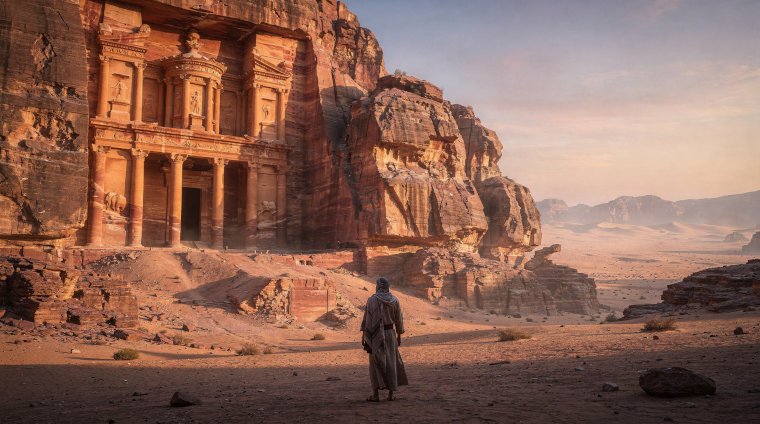
Saudi Arabia only opened to tourists in 2019 and since then it has managed to surprise even the sceptics. The main attractions include: Al-Hijr (the Saudi "Petra") — an ancient Nabataean city carved into the rock; Diriyah — the historical birthplace of the Al Saud dynasty on the outskirts of Riyadh; and Red Sea resorts with pristine coral reefs.
The image was generated using AI technologies
The tourist visa is obtained online in a matter of minutes, costs approximately $145 and is valid for one year with the option of multiple entries. For Russian citizens, this is an accessible option. Alcohol remains completely prohibited in the country; this is important to factor in from the outset. The dress code for foreign female tourists has become significantly more relaxed: modest clothing is encouraged, but the abaya is no longer obligatory.
The tourist infrastructure is being actively developed, but currently lags behind that of the Emirates. On the other hand, prices for accommodation and food are noticeably lower, and the number of tourists is incomparably smaller.
Expat life: where is it more comfortable?
If you are considering relocation, the difference between the countries is felt in financial and everyday terms on a daily basis.
The cost of living in the UAE is higher: the cost of renting a one-bedroom apartment in Dubai starts at $1,500 per month, with Abu Dhabi being slightly cheaper. Groceries, restaurants and transport are also more expensive than the regional average. However, the infrastructure — healthcare, education, roads and public transport — operates to the standards of the world's finest.
In Saudi Arabia, housing is cheaper: a flat in Riyadh will cost $800–$1,400 per month. Groceries and utility bills are also lower. Healthcare and education are well developed, particularly in major cities, but the choice of international schools and clinics is currently not as varied as in the UAE.
Safety is high in both countries: the level of street crime is extremely low. Families with children live comfortably in both.
Which country suits whom
The choice depends on what you are looking for:
The UAE suits those who want maximum entertainment, familiar comforts, freedom in terms of dress and food, and a quick start in a new country.
Saudi Arabia is for those seeking an authentic Arab experience, unspoilt nature, fewer tourists and who are prepared to observe stricter cultural norms.
For tourists from Russia, the practical advice is as follows: if you are visiting the Middle East for the first time, start with the UAE. It is easier to adapt there, Russian-language services are more widely available, and the logistics are straightforward. Saudi Arabia is worth considering as a next step — for those who are already familiar with the region and want to discover it from a different angle.
The difference in tourist experience between the UAE and Saudi Arabia is the difference between a polished resort and a living adventure. Both countries deserve attention, simply at different times and with different expectations.
Visa Requirements and Relocation: A Practical Guide
Obtaining a visa is the first practical step on the way to an actual relocation or trip. And here, Saudi Arabia and the United Arab Emirates offer fundamentally different conditions.
UAE visas: simple and swift
For Russian citizens and most citizens of the CIS countries, entry to the United Arab Emirates is organised in a maximally convenient manner. A visa on arrival is issued directly at the airport and grants the right to remain in the country for up to 30 days, with the option to extend for a further 30. An e-visa can be obtained online in advance; this process takes 2–3 working days.
The image was generated using AI technologies
Main types of UAE visas:
Tourist visa — 30 or 90 days, obtained online or through an airline.
Work visa — only through an employer, who acts as a sponsor.
Residency visa — issued if you have a job, business, or real estate.
Golden Visa — long-term residency for 5 or 10 years for foreign investors, entrepreneurs, specialists and their family members.
Premium Residency (Green Visa) — for freelancers and self-employed specialists without ties to an employer.
Saudi Arabia visas: reforms have opened the doors
Only a few years ago, it was practically impossible for a tourist to enter Saudi Arabia. Today, the situation has changed. The tourist e-visa can be obtained online at visitsaudi.com in 10–15 minutes, costs approximately 535 riyals (around $145) and grants the right to stay for up to 90 days within a year.
For working in Saudi Arabia, the kafala system applies — a sponsorship model under which the employer bears legal responsibility for the foreign employee. The system has been reformed: since 2021, workers have gained the right to change employers and leave the country without the employer's permission. This is an important change that has made the labour market more attractive for those considering emigration.
Residency: comparing the conditions
The UAE remains more flexible in matters of long-term residence. The Golden Visa is available with investments starting from 2 million dirhams in real estate or business — approximately $545,000.
Saudi Arabia has launched its own Premium Residency programme: a one-off payment of approximately 800,000 riyals (around $213,000), or an annual payment of 100,000 riyals, grants a permanent residence permit without ties to an employer.
By way of comparison: citizenship of Saint Kitts and Nevis through an investment programme costs at least $250,000 and provides a passport with visa-free access to more than 150 countries — a popular alternative for those considering not just relocation, but a change of citizenship.
Practical tips: what to prepare
Common mistakes when preparing documents:
Submitting an application at the last minute — allow a minimum of one week.
Discrepancies between data in the passport and the application form — check every letter.
Absence of a return ticket when applying for a tourist visa.
Expired medical insurance — in Saudi Arabia, valid medical insurance is mandatory.
An incorrectly stated address of accommodation — the specific hotel must be entered.
Documents required in both cases: a passport valid for at least 6 months, a photograph, proof of accommodation booking, a return ticket and insurance. For a work visa, additional documents will be required: a degree certificate with an apostille and an employment contract from the employer.
Frequently Asked Questions
Which is safer for a tourist — the UAE or Saudi Arabia?
Both countries are among the safest destinations in the Middle East in terms of street crime. The UAE is traditionally considered a more familiar environment for foreigners: well-developed tourist infrastructure and years of experience hosting visitors reduce the risk of cultural misunderstandings.
Saudi Arabia is also safe; however, unfamiliarity with local laws and religious norms can lead to unpleasant situations, especially for those visiting for the first time.
Is it possible to consume alcohol in the UAE and Saudi Arabia?
In Saudi Arabia, alcohol is completely prohibited — it will not be served in restaurants, hotels or private establishments, and bringing it across the border carries serious consequences.
In the UAE, the situation is fundamentally different: alcohol is legally sold in licensed establishments, bars and hotels, and tourists may consume it without restrictions in designated areas. Drinking in the street or in public places in the UAE is also prohibited — this is important to bear in mind so as not to break the law.
Where is it better to work — in the UAE or Saudi Arabia?
The UAE has historically attracted more foreign specialists: it is easier to set up a business, there is a wide selection of free economic zones and the working environment is more liberal.
Saudi Arabia is actively increasing its appeal to expatriates under Vision 2030, and salaries in a number of fields are comparable to, or even higher than, those in the Emirates. However, adapting to life in the Kingdom will require more time, owing to cultural particularities and stricter social norms.
Do Russians need a visa for the UAE?
Russian citizens do not need a visa for the UAE — entry is made under a visa-free arrangement for up to 90 days. This makes the Emirates one of the most accessible Middle Eastern destinations for Russian tourists and expatriates. For Saudi Arabia, Russian citizens are required to obtain a tourist visa, which can be obtained online through the official portal.
What is the main cultural difference between the UAE and Saudi Arabia?
UAE and Saudi Arabia. The difference between them is especially pronounced in cultural terms: the Emirates built their identity as an open, cosmopolitan hub, whereas Saudi Arabia remained a closed, conservative society for a long time.
The image was generated using AI technologies
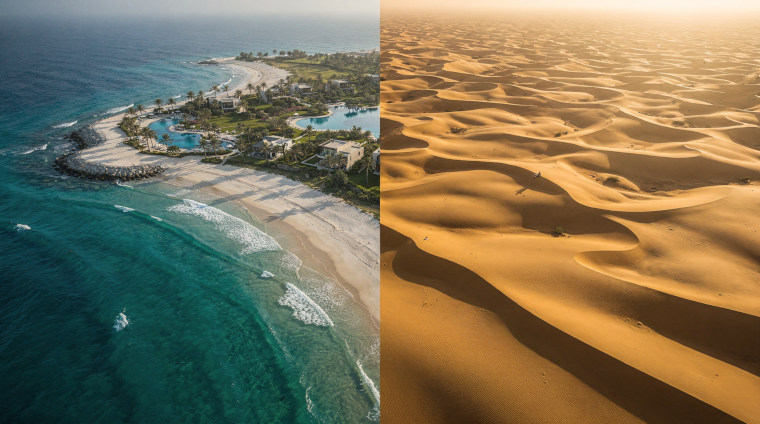
Today, the Kingdom is actively changing — cinemas, concert halls and mixed public spaces are opening — but the pace and depth of these changes still lag behind those of the Emirates. For a tourist, this means a different level of freedom in terms of behaviour, dress and leisure.
Which country is more expensive to live in — the UAE or Saudi Arabia?
When it comes to the UAE and Saudi Arabia and the difference between them in terms of the cost of living, the UAE — particularly Dubai and Abu Dhabi — consistently features among the most expensive cities in the world for rental accommodation and restaurant prices.
Saudi Arabia is generally less costly: prices for groceries, transport and utilities are noticeably lower there. That said, salary levels in both countries for qualified specialists remain high, which offsets the difference in expenditure.
Article header image was generated using AI technologies
General information about the Dubai Marina district. Hotels in the Dubai Marina district. Real estate in the Dubai Marina district. Transport in the Dubai Marina district. Popular restaurants in the D...
Distance and journey time from Dubai to Fujairah. Bus E700: the cheapest option. Taxi and transfer from Dubai to Fujairah. Driving from Dubai to Fujairah. How to get from Abu Dhabi to Fujairah? Conclu...
Population density of Dubai in 2025. Dubai’s Demographic Structure. Key growth factors of Dubai’s population. Specifics of life of the native citizens of the UAE and Dubai in particular. Frequently As...
Geographical position of Ajman. How to get to Ajman? General information about the city of Ajman. Main attractions and what to see. Frequently asked questions.
What is considered the centre of Dubai? Key attractions in the centre of Dubai. Real estate in the centre of Dubai. Central districts of Dubai for living. Practical tips on choosing a location in the ...
What Umm Suqeim is like. Real estate in Umm Suqeim. Features of residential real estate in Umm Suqeim. What affects commercial real estate prices? Entertainment in Umm Suqeim. Frequently asked questio...
What a flying taxi is and how it works. From the first flights to the present day: who is developing the flying taxi. Where air taxis are already flying: Dubai and other cities around the world. Why f...
Do Russians need a visa for Oman in 2026? Entry rules for Oman for Russians: documents and requirements. Visa for Oman for Russians in 2026: types, cost, and how to apply. Tourist visa for Oman for Ru...
What was before the beginning of the history of the UAE? Territories of the UAE in the 19th century. History of economic development of the UAE. The scandalous story of the UAE emir. Top 5 interesting...



 The image was generated using AI technologies
 The image was generated using AI technologies

 The image was generated using AI technologies

 The image was generated using AI technologies

 The image was generated using AI technologies

 The image was generated using AI technologies