UAE Flag: Photos, Meaning of Colours and Symbolism
Save the article:
Why study the national symbols of a distant country? The UAE flag is not merely a combination of colours on a piece of cloth — it is the encoded history of an entire people, their aspirations and values. For students and schoolchildren, studying the flag of the United Arab Emirates opens a window into the rich culture of the Middle East and helps them understand how a young state transformed itself into a prosperous nation in the space of half a century. Travellers planning a trip to Dubai or Abu Dhabi gain the opportunity to develop a deeper understanding for the local character and traditions.
What lies behind the seemingly simple four-stripe design? Each colour of the UAE flag carries deep symbolic meaning, reflecting Arab heritage and Islamic values. The red vertical stripe at the hoist and three horizontal stripes — green, white and black — tell the story of the unity of the seven emirates, their struggle for independence and their aspiration towards peace. In this article you will learn what the UAE flag looks like, discover the history of its creation and understand why these particular colours became the symbol of one of the most dynamically developing countries in the world.
What the UAE Flag Looks Like
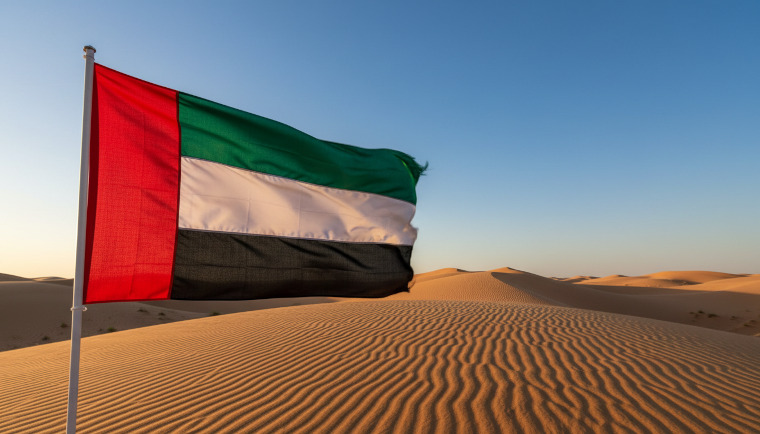
The flag of the United Arab Emirates is a rectangular banner with the classic proportions of 1:2, where the length is twice the width. The flag's design is both simple and expressive — it consists of four colours arranged in a distinctive geometric composition.
Arrangement of the colour elements
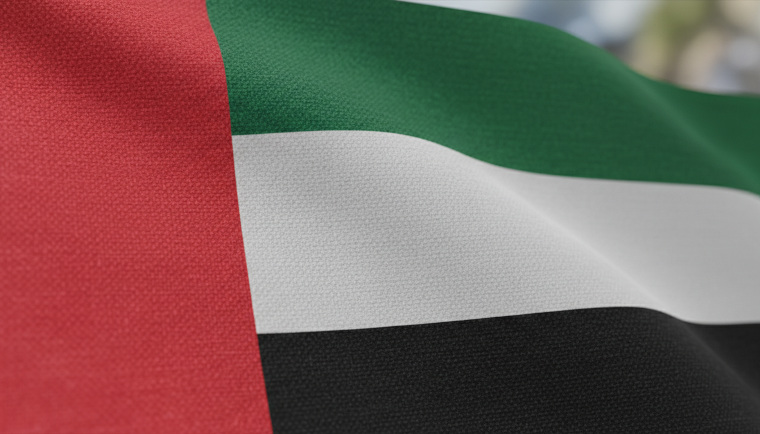
The base of the flag comprises three horizontal sections of equal width. The upper section is coloured green, the middle one is white, and the lower one is black. Each of these horizontal sections occupies one third of the flag's total width, creating a harmonious visual balance.
A distinctive feature of the design is a vertical red section positioned at the hoist edge of the flag. This section runs the full height of the banner and occupies one quarter of the flag's total length. The red section, in effect, unifies the three horizontal parts, creating a cohesive composition.
Exact proportions and dimensions
With the standard flag proportions of 1:2, the red vertical section occupies exactly 1/4 of the length, whilst the remaining 3/4 fall to the horizontal sections. If one imagines a flag 100 centimetres wide and 200 centimetres long, the red section would be 50 centimetres wide, and each horizontal section approximately 33.3 centimetres in height.
The visual impression of the flag
Photographs of the UAE flag demonstrate what this state symbol looks like under various lighting conditions. The contrasting combination of colours makes the flag easily recognisable even from a great distance. The red section creates a vivid accent that immediately draws the eye, whilst the horizontal sections form a calm background.
The flag's appearance has been designed in such a way as to ensure maximum recognisability on the international stage. The simple geometry and clear colour boundaries allow the flag's image to be reproduced at any size — from miniature lapel pins to enormous banners on state buildings.
This design has become so characteristic of the state that the flag is instantly associated with the country anywhere in the world, whether at sporting competitions, diplomatic meetings or in tourist brochures.
The historical roots of the symbolism reflect Arab traditions, in which green symbolises fertility, white represents peace, black stands for oil wealth, and red denotes unity. Historical documents attest that this combination of colours was not chosen arbitrarily and reflects the centuries-old traditions of the region.
The Meaning of the UAE Flag's Colours
Each colour on the flag of the United Arab Emirates carries deep meaning, reflecting the history, culture and aspirations of its people. Four colours — red, green, white and black — form a unified symbolic system that connects the modern UAE with its rich Arab traditions.
Red: the symbol of courage and resilience
The vertical red stripe at the hoist of the flag symbolises the courage, strength and resilience of the UAE's people. This colour embodies the heroism of ancestors who defended their land against invaders and fought for independence in the harsh conditions of the desert. Red also serves as a reminder of the sacrifices made in the name of uniting the seven emirate territories into a single country.
The image was generated using AI technologies
In Arab culture, red has traditionally been associated with the valour of warriors and the resolve of rulers. For the inhabitants of the UAE, this colour signifies a readiness to uphold one's principles and to defend the prosperity that has been achieved.
Green: prosperity and natural wealth
The green stripe on the flag represents prosperity, hope and the country's rich natural heritage. Despite the fact that the greater part of the UAE's territory consists of desert, the green colour symbolises the oases of life, fertile lands and the successful development of agriculture through modern technology.
This colour also reflects the country's economic prosperity and its commitment to sustainable development. Green serves as a reminder of the importance of preserving the environment and creating comfortable living conditions for future generations.
White: peace and national unity
The white stripe represents peace, purity and national unity. This colour symbolises the UAE's peaceable foreign policy and its commitment to the diplomatic resolution of conflicts. White also signifies honesty and openness in relations between the various peoples living in the country.
For the multinational society of the UAE, the white colour holds particular importance — it underscores the unity of all citizens regardless of their origins or religious beliefs. This colour reflects tolerance and mutual respect as the foundations of modern Emirati society.
Black: strength of spirit and resolve
The black stripe reflects strength of spirit and resolve in the struggle for independence. This colour symbolises the steadfastness of the Emirati people and their capacity to overcome any difficulties. Black also denotes the wealth of the subsoil — oil, which became the foundation of the UAE's economic miracle.
In the Islamic tradition, the black colour is associated with wisdom and dignity. For the UAE, this colour underscores the deep roots of Arab culture and adherence to Islamic values.
Connection with pan-Arab symbolism
The colour palette of the UAE flag is closely linked to pan-Arab symbolism, which unites Arab peoples through their shared history and culture. Red, green, white and black are traditional pan-Arab colours that have been used in various combinations on the flags of Arab states.
These colours trace their origins to the era of the Arab Caliphate and symbolise the unity of the Arab world. What does the UAE flag mean in the context of regional traditions? It means belonging to a great Arab civilisation and a readiness to maintain fraternal ties with neighbouring countries. The use of the pan-Arab palette underscores historical continuity and the cultural identity of the Emirati people.
The History of the UAE Flag's Creation
The UAE flag came into being as a result of the historic unification of seven territories under the leadership of the outstanding statesman Sheikh Zayed bin Sultan Al Nahyan. The process of creating a national symbol became a crucial part of the formation of the new nation, which was required to unite disparate regions into a single federal entity.
The unification of the territories and the role of Sheikh Zayed
On 2 December 1971, a momentous event took place in the history of the Arabian Peninsula — the formation of the United Arab Emirates. Sheikh Zayed, ruler of Abu Dhabi, was the driving force behind the creation of the federation, which united Abu Dhabi, Dubai, Sharjah, Ajman, Umm Al-Quwain, Fujairah and Ras Al-Khaimah.
The unification process required not only political negotiations but also the creation of new national symbols that would reflect the unity of all seven emirates.
Sheikh Zayed understood the importance of symbolism for a young country. The new flag was to serve as a unifying element that would help the inhabitants of the seven territories feel like citizens of a single federation. The country's leader personally took part in discussions on the design and symbolic meaning of the future flag.
The choice of design and the flag's creator
The design of the UAE flag was created by a young artist, Abdullah Mohammed Al Maainah, who was just 19 years old at the time. His design was chosen from among a great many submissions in a national competition organised by the government of the newly formed federation. Al Maainah proposed using traditional pan-Arab colours, but arranged them in a unique composition.
The artist drew inspiration from lines by the 13th-century Arab poet Safi al-Din al-Hilli: "White are our deeds, black our battles, green our fields, red our swords." These words perfectly encapsulated the philosophy of the new entity and became the foundation for the flag's colour scheme.
The symbolic rationale for the choice
Several important factors were taken into account when selecting the final design. Firstly, the flag had to reflect Arab identity and a connection with the pan-Arab movement. Secondly, the design needed to be simple and recognisable, so that citizens could easily remember and identify the national symbol.
The arrangement of the colours also carried deep significance. The vertical red stripe at the hoist symbolised the strength and unity that bind all the principalities together. The horizontal stripes — green, white and black — represented various aspects of life in the young federation: prosperity, peace and victory over hardship.
Official adoption and first raising
The official adoption of the flag took place simultaneously with the proclamation of UAE independence. The first ceremonial raising of the flag occurred in the presence of all the rulers of the emirates, symbolising their unity and willingness to work together for a shared future. This moment became a turning point in the history of the region, marking the beginning of a new era of development and prosperity.
The Use of the Flag in the Modern UAE
In the modern United Arab Emirates, the UAE flag is an integral part of state and public life. It can be seen virtually everywhere — from the official residences of rulers to school classrooms, where children study the history of their country. The state symbol plays an important role in shaping national identity and demonstrating the unity of the seven emirates.
Official use of the flag
The UAE flag adorns all government buildings, and is obligatorily raised above the residences of the emirates' rulers, ministries, courts and municipal institutions. In Abu Dhabi, the capital of the federation, the flag flies with particular solemnity above the presidential palace of Qasr Al-Watan, where the most important state ceremonies take place.
In all schools throughout the country, the day begins with the raising of the flag and the performance of the national anthem. This helps the younger generation understand what the UAE flag means and fosters a sense of patriotism. At universities and colleges, the flag also occupies a place of honour during graduation ceremonies and academic events.
Flag Day — a celebration of national unity
On 3 November, the UAE marks a special occasion — Flag Day, established in 2013 at the initiative of the Crown Prince of Dubai, Sheikh Hamdan bin Mohammed. On this day, solemn flag-raising ceremonies take place throughout the country, in which millions of residents take part.
The image was generated using AI technologies
The celebration's traditions include mass flash mobs, when thousands of people simultaneously raise their flags at 11:00 in the morning. The colours of the UAE flag are visible everywhere on this day: on citizens' clothing, on the decorations of buildings, on cars. Schoolchildren prepare special performances telling the story of what the UAE flag looks like and what history it symbolises.
Protocol and rules of conduct
There are strict rules of etiquette governing the handling of the state flag. The flag must never touch the ground, and it may not be used for commercial purposes without special permission. When raising the flag, a particular ceremony is observed: the banner is raised slowly and solemnly, and lowered at the same pace.
During international events, the UAE flag occupies a place of honour alongside the symbols of other states. At sporting competitions, such as Formula 1 in Abu Dhabi or tennis tournaments in Dubai, the flag becomes a symbol of the country's hospitality and prestige.
Significance for tourists
For travellers, an understanding of the flag's symbolism opens up a deeper understanding of Emirati culture. Knowing what the UAE flag means helps tourists better understand the values of local society — the aspiration towards peace, prosperity and unity.
This is particularly important when attending cultural events and national celebrations, where respect for national symbols is an expression of courtesy and cultural awareness.
With each passing year, the interest of the emirates' visitors in the country's symbolism continues to grow.
Frequently Asked Questions
When was the flag of the United Arab Emirates adopted?
The modern flag of the country was officially adopted on 2 December 1971, on the day the independent federal state was proclaimed. This historic moment became a symbol of the unification of the seven emirates into a single nation. The flag's design was approved simultaneously with the adoption of the young country's constitution. Since its approval, the symbol has remained unchanged and continues to serve as the principal state emblem of the federation.
What do the four colours of the United Arab Emirates flag mean?
Red symbolises the courage, strength and resilience of the people in their struggle for independence. Green represents hope, joy and prosperity, as well as the rich oases amid the desert. White signifies purity of intention, peace and the honesty of the ruling dynasty. Black reflects the resolve to overcome enemies and defend the homeland from any threat.
When is Flag Day celebrated in the United Arab Emirates?
Flag Day in the federal state is celebrated annually on 3 November, beginning in 2013. This national holiday was established at the initiative of the Crown Prince of Dubai, Sheikh Hamdan bin Mohammed Al Maktoum. On this day, solemn flag-raising ceremonies take place throughout the country, in which government officials, schoolchildren and ordinary citizens participate. The events are aimed at strengthening national unity and pride in the country's achievements.
May the flag be used for commercial purposes?
The use of the state flag for commercial purposes is strictly regulated by local legislation. It is prohibited to place the symbol on consumer goods, advertising materials, or to use it as a trade mark. Violation of these rules may entail serious administrative penalties.
However, the use of the national colour palette and symbolism is permitted at patriotic events and in state projects with the appropriate authorisations.
Does the flag differ from the flags of other Arab countries?
The flag does indeed have a unique design among Arab states, even though it uses traditional pan-Arab colours. The principal distinguishing feature lies in the placement of the red vertical section at the hoist, whereas in the majority of Arab countries this colour is arranged horizontally.
This composition makes the symbol easily recognisable on the international stage. The combination of vertical and horizontal elements creates a unique geometry that is not replicated in any other national symbol in the region.
Where are tourists most likely to see the flag?
Tourists may see the flag virtually everywhere during their travels around the country. The state symbol is most commonly encountered at the entrances to hotels, shopping centres, government buildings and cultural attractions in Dubai, Abu Dhabi and other regions.
The flag is invariably present at airports, at border crossings and at official ceremonies. Many tourists take photos of the UAE flag against the backdrop of famous landmarks, such as the Burj Khalifa or the Sheikh Zayed Grand Mosque.
Article header image was generated using AI technologies
The Emirate of Fujairah is an excellent place for relocation. It is the only emirate in the UAE located on the shore of the Arabian Sea of the Indian Ocean.
Main features of the Al Manara district in Dubai. Infrastructure of Al Manara. Renting and buying property in Al Manara. Food market in Al Manara. Frequently asked questions about Al Manara.
Do Russians need a visa for Oman in 2026? Entry rules for Oman for Russians: documents and requirements. Visa for Oman for Russians in 2026: types, cost, and how to apply. Tourist visa for Oman for Ru...
Where to invest money in the near future? Where to invest money in the UAE? Attractiveness of investing money in the UAE. Investment directions in the UAE. Investing in UAE real estate. Investment obj...
Where to buy a car in Dubai? Car registration and ownership costs in Dubai. Fines and driving rules in Dubai. Car rental in Dubai. Frequently asked questions about cars in Dubai.
Abu Dhabi bus system. Hafilat card: payment and use. Fares and tariffs. Free buses and special services. Practical tips for using public transport. FAQ.
Pros and cons of an autumn holiday in Dubai. Autumn weather in Dubai. Which autumn month is best for visiting Dubai? Dubai's beaches. Dubai's sights. Entertainment events in Dubai in autumn 2026. How ...
Top countries to live in 2026. Dubai as the best destination for relocation. Best countries to live in with children. How to choose a country for relocation: a practical guide. Frequently asked questi...



 The image was generated using AI technologies


 The image was generated using AI technologies