Home/Middle East/The History of Saudi Arabia: From Its Origins to the Present Day
28.07.2026
Middle East
1213
Reading time: 15 minutes
The History of Saudi Arabia: From Its Origins to the Present Day
Save the article:
What problem do you run into when you start studying the history of Saudi Arabia? Usually it's a huge amount of scattered information: some sources talk about the ancient trade routes of the Arabian Peninsula, others about religious movements of the 18th century, and still others about the modern politics of the kingdom. Schoolchildren and students need a concise structure for a paper, history enthusiasts want deep context on the unification of the Arabian lands, and travelers want to understand the cultural roots before a trip to the region. The history of the state of Saudi Arabia really is multilayered: it includes tribal alliances, religious reforms, territorial wars, and the rise of the ruling House of Saud. It's difficult to make sense of all this without a clear chronological outline, and there's often not enough time for independent research.
What will you gain from reading this material? We will walk step by step through how Saudi Arabia country's history took shape — from scattered Bedouin tribes to a unified kingdom — who stood at the origins of unification, and why the flag of Saudi Arabia, whose history is closely tied to religion and statehood, looks the way it does. You will learn the exact dates of the state's formation, the role of key historical figures, and the symbolic meaning of the green banner with the shahada and the sword. The material is organized by period, so it's easy to use as the basis for a report or as a reference before traveling. After reading, you will have a complete picture of how the history of Saudi Arabia turned from local conflicts into the story of one of the most influential states in the Middle East.
The Arabian Peninsula Before the Formation of the Saudi State
For centuries, the Arabian Peninsula remained a territory where harsh nature dictated the rules of life. Deserts covered most of the land, and rare water sources became points of attraction for entire peoples. To understand how a powerful state later emerged there, it's important to first understand how people lived long before that event.
Tribes and Oases: Sources of Life in the Desert
The main social unit on the peninsula was the tribe. Each one united dozens or hundreds of families connected by blood ties and shared customs. The tribal structure determined everything, from the distribution of pastures to the rules of blood feuds. There was no formal authority as such; decisions were made by a council of elders, and a chief's authority rested on respect rather than law.
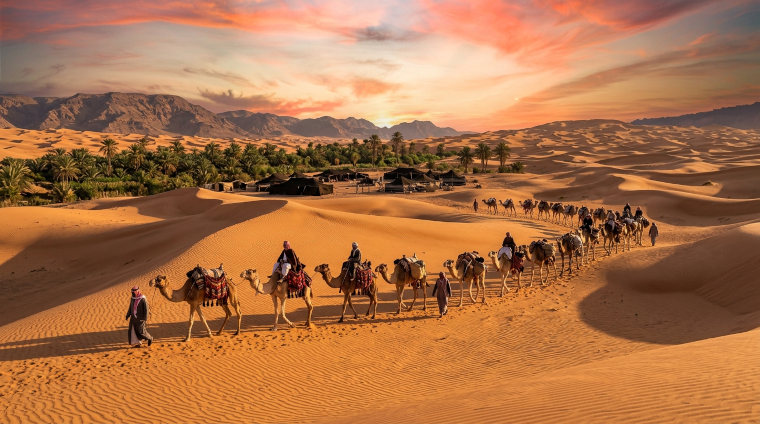
The life of the Bedouins, nomadic Arabs, was built around moving between pastures and water sources. Oases served as true islands of life amid the sands — date palms grew there, grain was cultivated, and livestock was raised. Around large oases such as Al-Hofuf or Tabuk, permanent settlements formed, which became hubs of trade and exchange.
The image was generated using AI technologies
Ancient trade routes connecting India, East Africa, and the Mediterranean passed through the Arabian Peninsula. Caravans carried incense, spices, fabrics, and precious stones. Control over these routes brought wealth and influence to the tribes, which is why valuable territories were often fought over.
Mecca and Medina: The Spiritual Centers of Arabia
Even before the emergence of Islam, Mecca was the region's most important religious and trading center. The city was home to the Kaaba — a shrine that drew pilgrims from various tribes to worship their deities. Fairs held alongside religious ceremonies turned Mecca into a meeting place for merchants, poets, and travelers from all over Arabia.
Medina, located further north, was known for its fertile land and developed agriculture. It was there that the Prophet Muhammad relocated in 622 — an event known as the Hijrah, which became the starting point of the Muslim calendar.
The Rise of Islam and the Unification of the Tribes
At the beginning of the 7th century, Islam emerged on the Arabian Peninsula — a monotheistic religion that changed the course of history for the entire region. Muhammad's preaching called for abandoning inter-tribal enmity and uniting around belief in one God.
By the time the Prophet died in 632, a significant portion of the Arabian tribes had already converted to Islam. This led to the formation of the caliphate — a state united by both religious and political authority. Muslims gained common laws, a single calendar, and a powerful impetus for further conquest. Islam became the unifying force that the scattered desert tribes had previously lacked.
After Muhammad's death, the center of political life gradually shifted outside Arabia — to Damascus, and then to Baghdad. The peninsula itself, especially its interior regions, once again fell into relative isolation, preserving its tribal way of life for centuries.
Arabia Under Ottoman Rule
By the 16th century, a significant part of the Arabian Peninsula had come under the nominal control of the Ottoman Empire. The Turks established influence primarily in coastal areas — the Hejaz with Mecca and Medina, and partly in Al-Ahsa in the east. Administration was carried out through appointed pashas — governors who represented Istanbul's interests locally.
However, actual Ottoman authority rarely reached the interior regions. The Najd region, located in the center of the peninsula, remained essentially independent. The Turks had neither the resources nor the desire to control the arid inland territories, which lacked significant trade revenue.
Key features of the Ottoman presence in Arabia:
control was concentrated in coastal zones and the holy cities;
the interior territories of Najd retained tribal autonomy;
local sheikhs and emirs effectively governed their lands independently;
Ottoman administration was limited to collecting symbolic tribute and protecting pilgrimage routes.
It was precisely this lack of authority in the central region that created the conditions under which new political forces began to form in the interior regions of Arabia. The history of the Saudi state begins in the sands of Najd, a place Istanbul's reach barely extended to.
The First and Second Saudi States
The history of the House of Saud begins with an event that forever changed the political map of the Arabian Peninsula. In 1744, an alliance was formed that became the foundation for the future kingdom — an agreement between the ruler of the small settlement of Diriyah and a religious reformer preaching a return to the strict principles of Islam.
The Alliance That Founded the Dynasty
Muhammad ibn Abd al-Wahhab was a theologian who called for purifying religious practice of innovations and returning to the original foundations of the faith. His teaching later came to be known as Wahhabism. Seeking a patron capable of protecting and spreading his ideas, the preacher turned to Emir Muhammad ibn Saud, who ruled the small oasis of Diriyah.
Their agreement proved mutually beneficial. Ibn Saud gained religious legitimacy and a powerful ideological foundation for expanding his authority, while ibn Abd al-Wahhab gained military strength to spread his teaching. This is how the first Saudi state was founded, with its capital in Diriyah — a small town in the Najd region that became a symbol of the birth of a new dynasty.
The First Saudi State: From Najd to the Borders of the Ottoman Empire
The first Saudi state quickly grew in strength. By the end of the 18th century, a significant part of the Arabian Peninsula had come under the rule of the House of Saud, including the Hejaz with its holy cities of Mecca and Medina. Such territorial expansion could not go unnoticed by the Ottoman Empire, which formally considered these lands to be within its sphere of influence.
The main directions of the state's expansion were as follows:
the conquest of Najd and the unification of scattered tribal territories;
the annexation of the peninsula's eastern regions, including Al-Hasa;
the capture of the holy cities of the Hejaz in 1803–1806;
raids into the territories of present-day Iraq and Kuwait.
Wars against the Ottoman Empire became an inevitable consequence of this policy. The Turkish authorities viewed the growing power of the Saudis as a direct threat to their authority in the Muslim world, since control over Mecca and Medina traditionally granted religious legitimacy to the ruling dynasty.
The Defeat of 1818: The End of the First State
The Ottoman sultan tasked his vassal — the ruler of Egypt, Muhammad Ali — with suppressing the Saudi movement. The military campaign dragged on for several years and was marked by particular brutality. In 1818, Turkish-Egyptian forces under the command of Ibrahim Pasha, the Egyptian ruler's son, took the capital of Diriyah after a prolonged siege.
The city was practically razed to the ground, and the leader of the Saudis at the time was sent to Istanbul, where he was publicly executed. The first Saudi state ceased to exist 74 years after its founding. It seemed the House of Saud had vanished from the political scene of Arabia forever, but history had other plans.
The Second Saudi State: Revival in Riyadh
As early as 1824, just six years after the catastrophe, representatives of the dynasty managed to restore power over part of the lost territories. The new center became Riyadh — a city that would later become the capital of the modern kingdom. The second Saudi state was founded on the same Wahhabist ideological principles as the first, but operated within far more modest borders.
The rule of this period was marked by instability. The state's territory was limited mostly to the Najd region, and its foreign policy was built on cautious balancing between the interests of the Ottoman Empire and the growing influence of local rivals.
Internal Conflicts and Rebellion Within the Dynasty
The main problem of the second Saudi state was not external enemies, but internal strife. The struggle for power among various branches of the House of Saud regularly erupted into open rebellion, weakening the ruling house's position. Brothers and nephews replaced one another as imam, often forcibly removing their predecessors.
This instability created fertile ground for the strengthening of rivals. The most serious threat came from the Rashidi dynasty, which ruled the neighboring Emirate of Ha’il and relied on the support of the powerful Shammar tribal confederation. While the Saudis exhausted their strength in internal strife, the Rashidis steadily consolidated their own position.
By the end of the 19th century, the rivalry between the two dynasties reached a critical point. In 1891, Rashidi forces decisively defeated the Saudis at the Battle of Mulayda. The second Saudi state effectively ceased to exist, and members of the House of Saud were forced to leave Arabia and seek refuge in Kuwait.
Emir Abdul Rahman bin Faisal, the last ruler of the second state, took his family into exile, bringing with him his young son, Abdulaziz — the future founder of the modern kingdom. It was this young man who, years later, was destined to return to his homeland and begin a new stage in the struggle to unite the Arabian lands under his dynasty's rule.
The Creation of the Modern Kingdom of Saudi Arabia
The history of the modern Saudi state is inseparably tied to the name of one man — Abdulaziz bin Abdul Rahman Al Saud, also known as Ibn Saud. It was he who united the disparate Arabian lands into a single whole and created a state that still exists today. His path from exile to the founding of a monarchy took him more than three decades of persistent struggle, diplomacy, and military campaigns.
The Return and Capture of Riyadh in 1902
By the end of the 19th century, the House of Saud was living in exile in Kuwait, having lost control of its ancestral lands. Young Abdulaziz, who was about twenty years old at the time, decided to reclaim his lost heritage by force.
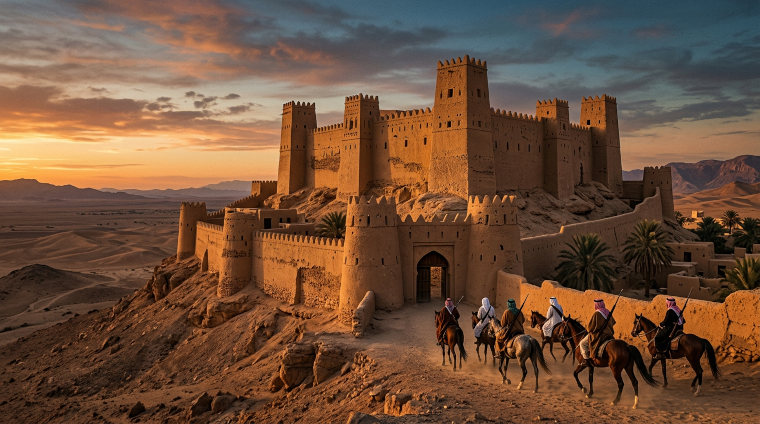
In January 1902, together with a small group of loyal followers, he carried out a nighttime assault on the Masmak fortress in Riyadh. It was then that Ibn Saud seized Riyadh, removing the governor of the rival Rashidi dynasty and returning the city to his family's rule. This event became the starting point of the entire subsequent history of the unification of Arabia, and a symbolic beginning of the dynasty's revival.
The image was generated using AI technologies
The Conquest of Najd and the Struggle for Central Arabia
After establishing himself in Riyadh, Abdulaziz focused on strengthening his authority over the entire Najd region — the vast central area of the peninsula. In the years that followed, he waged wars against the Rashidi dynasty, whose stronghold was the city of Hail in the Jabal Shammar region.
The struggle dragged on for nearly two decades: only in 1921 did Ibn Saud's forces finally defeat the Rashidis and annex their possessions. This marked the beginning of the formation of a unified territory under the rule of a single family and opened the way for the further expansion of the future state's borders.
The Annexation of the Hejaz, Mecca, and Medina
The conquest of the Hejaz (the western part of the peninsula, home to the cities of Mecca and Medina, sacred to Muslims) was of particular importance. Until 1925, these territories were governed by the Hashemite dynasty. Abdulaziz carried out a series of military campaigns, as a result of which the Hejaz came under his control.
The capture of Mecca in 1924 and Medina in 1925 had not only military but also religious significance: a ruler who controlled the holy sites of Islam gained tremendous authority throughout the Muslim world. This is how the unified realm known as the Kingdom of Hejaz and Nejd came into being — the direct predecessor of the future Kingdom of Saudi Arabia.
Asir, Eastern Arabia, and the Role of British Support
Alongside the conquest of the Hejaz, Ibn Saud extended his influence to other regions as well. Eastern Arabia was annexed as early as 1913, after Ottoman garrisons were pushed out of the area. The mountainous Asir region in the southwest of the peninsula was incorporated into Abdulaziz's domains in the late 1920s.
British support played an important role in strengthening Ibn Saud's position. Great Britain, interested in the region's stability and in weakening Ottoman influence, signed a treaty with Abdulaziz at Uqair in 1915, recognizing his authority over Najd and the surrounding territories. Later, the borders of the new states were secured through a series of agreements with neighboring countries:
The 1922 Uqair Convention defined the borders with Iraq and Kuwait.
Treaties with Transjordan clarified the northern boundaries of the domain.
Agreements with Yemen defined the southern borders after the annexation of Asir.
These agreements allowed Ibn Saud to avoid major conflicts with the colonial powers and to focus on the internal unification of the Arab lands.
The Proclamation of the Kingdom on September 23, 1932
By the early 1930s, Abdulaziz controlled nearly the entire Arabian Peninsula, with the exception of small territories in the south and east that were under British protectorate. The time had come to formally establish the new state.
On September 23, 1932, Ibn Saud proclaimed the unification of his domains under a single name — the Kingdom of Saudi Arabia. This date is celebrated in the country as a national holiday and is considered the birthday of the modern state.
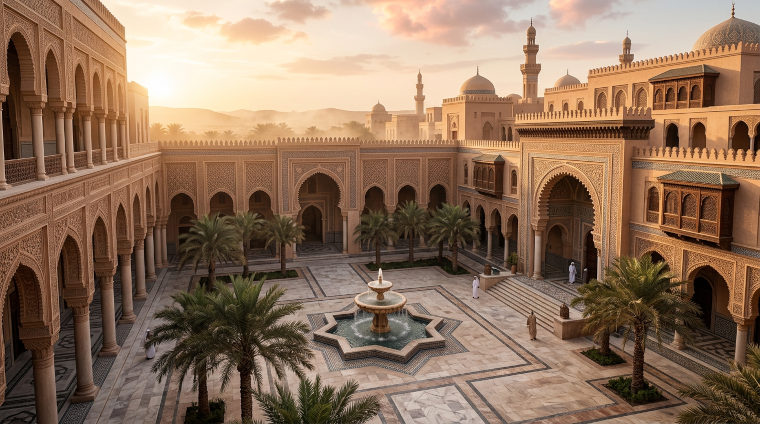
The kingdom's name carried a double meaning: it referred both to the territory of Arabia and to the ruling House of Saud, which gave the country its name. This decision underscored the inseparable link between the state and the family of its founder — a model of governance that has endured to this day.
The image was generated using AI technologies
The Role of the House of Saud in the Formation of the State
From the very beginning, the House of Saud acted not merely as a ruling clan, but as a unifying force for the various tribes and regions of the peninsula. Abdulaziz skillfully combined military strength, religious authority, and diplomatic alliances, including marital ties with influential families. Through this approach, he managed to create a state in which central authority relied on a broad network of kinship and allied relationships.
After Abdulaziz's death in 1953, the throne passed among his numerous sons — a practice that continues to this day. This system of succession ensured the stability of the monarchy for decades and allowed the House of Saud to remain the country's sole ruling house since its founding.
The Development of Saudi Arabia in the 20th–21st Centuries
After Abdulaziz's death in 1953, the young state faced the task of transforming a desert kingdom into a modern economic power. Oil, discovered even before the Second World War but only truly realizing its potential in the postwar decades, played a key role. Oil revenues became the foundation on which the entire structure of modern Saudi Arabia was built.
The Oil Era and the Birth of a New Type of Economy
In 1938, American geologists from Standard Oil of California discovered a large oil field in the Dammam area. This discovery changed the country's fate forever. Industrial extraction began as early as the late 1930s, but full-scale exports only got underway after the end of the Second World War, when the global economy began to recover and was in dire need of energy resources.
By the 1960s, Saudi Arabia had become one of the world's largest oil exporters. In 1960, the kingdom became one of the founding members of OPEC — the Organization of the Petroleum Exporting Countries — which still influences global energy prices today. Oil revenues allowed the state to build roads, schools, hospitals, and universities in places where there had previously been only caravan trails.
The country's economy quickly shifted, moving from nomadic herding and trade toward extractive industry and government investment. It was oil that made possible the large-scale modernization known around the world today.
The Successor Kings and the Path of Modernization
After Abdulaziz, the throne was occupied by his sons, each of whom made his own contribution to the country's development.
King Saud ruled from 1953 to 1964 and struggled to manage the growing oil revenues. Domestic policy under his rule was unstable, leading to his abdication in favor of his brother.
King Faisal, who ruled from 1964 to 1975, is considered one of the most significant reformers in the country's history. It was under his rule that the state budget began to be systematized, television appeared, slavery was abolished, and education became accessible to broad segments of the population.
King Faisal's foreign policy was marked by an active stance on the international stage; he strengthened ties with Arab neighbors and supported pan-Islamic cooperation.
King Khalid (1975–1982) continued the course toward industrialization, while under King Fahd (1982–2005) the country experienced rapid economic growth thanks to high oil prices. King Abdullah, who ruled from 2005 to 2015, initiated the first cautious social reforms, including expanding educational opportunities for women.
The Era of King Salman and New Reforms
King Salman bin Abdulaziz has been in power since 2015. It is under his rule that the country has entered a period of the most sweeping transformations in its history. Crown Prince Mohammed bin Salman, who effectively runs the kingdom's day-to-day policy, initiated the Vision 2030 program.
What is Vision 2030? It is a state strategy aimed at reducing the economy's dependence on oil and developing tourism, technology, and industry.
The main directions of the reforms include:
diversifying the economy and creating non-oil industries;
developing tourism, including opening the country to foreign travelers;
expanding women's rights, including the right to drive a car starting in 2018 and to work in new professional fields;
building megaprojects, such as the futuristic city of NEOM;
easing certain social restrictions in public life.
Women's rights issues occupy a special place in these reforms. Just ten years ago, many areas of life were closed to women, but today they work in business, sports, culture, and government structures.
The Foreign Policy of Modern Saudi Arabia
The kingdom's foreign policy has traditionally been built on close partnership with the United States, which began under Abdulaziz and was strengthened by subsequent rulers. The United States has long remained the main ally in matters of security and arms supplies.
In recent years, Saudi Arabia has been expanding contacts with other major powers as well. Relations with Russia have notably intensified within the framework of the OPEC+ oil alliance, where the two countries coordinate production volumes to stabilize global prices.
Meetings between representatives of the kingdom and Vladimir Putin have repeatedly been covered by the international press as an example of pragmatic cooperation that goes beyond traditional geopolitical alliances.
Today, the country's foreign policy is built on a multi-vector approach: while maintaining its strategic partnership with the West, the kingdom is simultaneously developing ties with China, Asian countries, and its regional neighbors. This approach reflects the overall logic of the current reforms — diversification not only of the economy, but of international relations as well.
The History of the Saudi Arabian Flag and Its Symbolism
The flag of Saudi Arabia is recognizable at a glance: a green banner with white Arabic script and a sword beneath it. But behind this concise design lies a deep religious and historical meaning that not everyone understands. The history of the Saudi Arabian flag is closely intertwined with the history of Islam and the rise of the House of Saud, so understanding its symbolism means better understanding the kingdom itself.
The Color Green
The color green was not chosen by accident. In Islamic tradition, it is associated with paradise, life, and prosperity — according to tradition, it was this very shade that the Prophet Muhammad used. Many Muslim states use green in their symbolism, but the Saudi flag made it the foundation rather than just an accent. This choice underscores that the state was built first and foremost as a stronghold of Islam on the Arabian Peninsula.
The Shahada: The Heart of the Flag
At the center of the banner, written in white script, is the shahada — the declaration of faith, the key formula of Islam. It reads: "There is no god but Allah, and Muhammad is the Messenger of Allah." This is not merely decoration, but a sacred text that every Muslim recites upon embracing the faith.
It is precisely the presence of the shahada that makes the Saudi flag unique among the world's state symbols: such text on a national flag is extremely rare.
The Sword as a Symbol of Strength and Justice
Beneath the inscription is a horizontal sword. It commemorates the military victories through which the House of Saud united scattered lands into a single state. At the same time, the sword is interpreted as a symbol of justice and determination to defend the faith. In Arab culture, the sword has long been associated not with aggression, but with the readiness to uphold truth and order — this is the meaning implied in the image on the flag.
When the Flag Took Its Current Form
The first versions of the green flag bearing the inscription appeared as early as the beginning of the 20th century, during Abdulaziz's struggle to unify the Arabian territories. However, the modern flag was officially adopted on March 15, 1973, long after the kingdom had already been established in 1932. Since then, the proportions, the script of the inscription, and the placement of the sword have been legally established and have not changed.
Special Rules for Handling the Flag
Because the banner bears sacred text, special rules established by the state apply to the flag:
it is forbidden to print the flag on T-shirts, souvenirs, dishware, and other mass consumer goods;
the flag may not be flown upside down or used in a torn or dirty condition;
unlike in many countries, lowering the flag to half-mast as a sign of mourning is not practiced in Saudi Arabia, as it would be considered disrespectful to the shahada;
the depiction of the flag in advertising or on packaging is also restricted.
This attitude is simply explained: the shahada is not a decoration, but part of the religious canon, and it must be treated with due reverence.
How the Saudi Flag Differs from the Flags of Other Muslim Countries
Many states in the Arab and Muslim world use green, the crescent moon, or religious quotations. But it is precisely the combination of the full text of the shahada and the image of a sword that makes the flag of Saudi Arabia an exception.
For example, the flags of Pakistan or Turkey rely on the crescent and star rather than a direct quotation from religious doctrine. This distinction underscores the kingdom's special role as the guardian of Islam's two holiest sites — Mecca and Medina — which is reflected in the country's main symbol.
Frequently Asked Questions
What was the territory of modern Saudi Arabia called before?
Before the formation of a unified state, these lands were simply called the Arabian Peninsula and were divided into several historical and geographic regions: Najd in the central part, the Hejaz in the west with the holy cities of Mecca and Medina, Asir in the south, and Al-Hasa in the east.
The territory had no single name, since each region was governed by its own tribal chiefs or was under the influence of neighboring empires. The name "Saudi Arabia" only appeared in the 20th century, thanks to the House of Saud, which unified these lands. That is why the history of the state of Saudi Arabia effectively begins with the unification of scattered regions into a single whole.
When was the first Saudi state founded?
The first Saudi state was founded in 1744 as a result of an alliance between the ruler of Diriyah, Muhammad bin Saud, and the religious reformer Muhammad ibn Abd al-Wahhab. This alliance united military and religious authority, allowing for active expansion into neighboring territories of Najd.
The state existed until 1818, when it was destroyed by Egyptian forces acting on behalf of the Ottoman Empire. However, this period is considered the foundation of the entire subsequent history of Saudi Arabia.
Who founded the modern Kingdom of Saudi Arabia?
The modern kingdom was created by Abdulaziz bin Abdul Rahman Al Saud, better known as Ibn Saud. In 1902, he captured Riyadh, restoring his family's control over its ancestral lands, and then, over the course of three decades, united Najd, the Hejaz, Asir, and other regions under his rule. The kingdom was officially proclaimed on September 23, 1932. This date is still celebrated as the country's national holiday.
What do the green color and the sword on the Saudi Arabian flag symbolize?
The green color of the flag is traditionally associated with Islam and symbolizes life, prosperity, and the ruling dynasty's religious devotion. The sword depicted beneath the Arabic inscription represents the military strength and determination with which the House of Saud unified the Arabian lands.
The inscription on the flag is the shahada — the Islamic declaration of faith, underscoring the close link between the state and religion. This combination of symbols makes the flag of Saudi Arabia one of the most recognizable in the Arab world.
Why is Saudi Arabia considered a wealthy country?
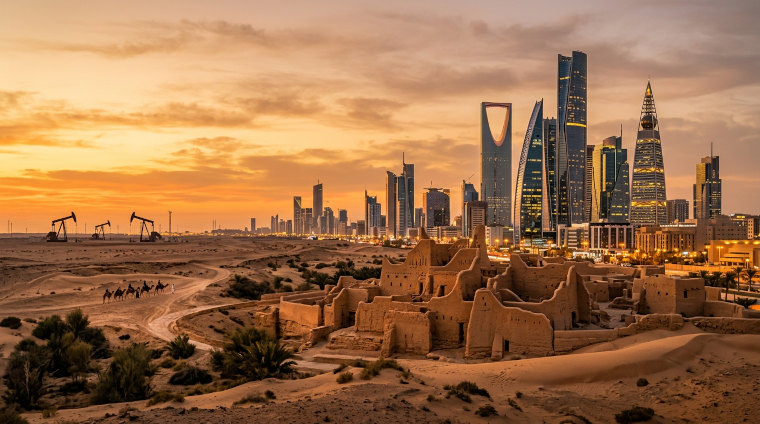
The foundation of the kingdom's wealth is oil, discovered in the country's eastern provinces in the 1930s, which allowed large-scale extraction to begin after the Second World War. Saudi Arabia is one of the leading members of OPEC and holds some of the largest proven oil reserves in the world.
Revenues from oil sales allowed the government to invest enormous sums in the development of infrastructure, education, and healthcare. As a result, the country transformed from a poor desert region into one of the leading economies in the Middle East.
The image was generated using AI technologies
What kind of relations exist between Saudi Arabia and Russia?
Diplomatic relations between the two countries were established as early as 1926, though the active development of ties began much later, within the framework of cooperation through OPEC+. Today, Russia and Saudi Arabia maintain dialogue on issues of the oil market, regional security, and economic cooperation.
Contacts are maintained at a high level, including meetings and negotiations involving Russian President Vladimir Putin. This cooperation remains an important part of both countries' foreign policy.
Article header image was generated using AI technologies
Dubai as a city attractive to crypto investors. Types of crypto banking accounts that can be opened in Dubai. Specifics of cryptocurrency exchange in Dubai. Crypto zones in Dubai. Cryptocurrency regul...
Do Russians need a visa for the UAE and how do you obtain one? What documents are required to enter the UAE? What are the differences between entry rules for Dubai, Sharjah and Abu Dhabi? What you nee...
Qatar: essential facts before your trip. What to see in Doha: the main attractions. Attractions outside Doha. Practical tips: itineraries, food, and shopping. Frequently asked questions.
Specifics of marriage between non-Muslims in the UAE. Marriage according to Sharia law. Legal requirements for those getting married in the UAE. What documents are needed to get married in the UAE? Ho...
Specifics of Carrefour in Dubai. Average food prices in Dubai in 2025. Must-buy items in Dubai supermarkets. Competitors of Carrefour Dubai. Frequently asked questions about Carrefour Dubai.
Moving to and living in Dubai attracts many people. This is not surprising: high level of comfort and almost absolute security, first-class healthcare and excellent education system, low taxes.
General situation regarding safety in the UAE for tourists. Safety of women in the UAE. Rules of conduct for tourists in the UAE. How safe is public transport in the UAE for tourists? What is prohibit...
11 official festivals in Dubai and the UAE. Non-muslim festivals celebrated in the UAE and Dubai. Other festival celebrations in Dubai and the UAE. Frequently asked questions about festivals in Dubai.



 The image was generated using AI technologies


 The image was generated using AI technologies

 The image was generated using AI technologies


 The image was generated using AI technologies