Home/Middle East/Northern Cyprus Currency: What You Need to Know Before Your Trip
22.10.2026
Middle East
1078
Reading time: 15 minutes
Northern Cyprus Currency: What You Need to Know Before Your Trip
Save the article:
Planning a trip to Northern Cyprus and not sure which currency to take with you? This is the most common question asked by people planning their first trip to this part of the island. Let us reassure you: the main local currency of Northern Cyprus is the Turkish lira, although some establishments also accept euros, pounds sterling and dollars.
This is because the north of the island is closely tied to Turkey, while the southern, internationally recognised part of Cyprus uses the euro — hence the confusion among tourists who are trying to find out which currency is used in Northern Cyprus right now, in 2026. We will not go into politics here, only the practical side of the matter, which actually affects your wallet.
What will you get from reading this article? We will look at where it is best to exchange money, whether it is worth paying in euros or dollars, how bank cards and cash machines work, and how to calculate your travel budget properly, taking the lira’s exchange rate into account.
We will also look separately at the points that matter to those buying property in Cyprus or planning to relocate — we will explain which currencies are used for transactions and how to protect your savings from inflation. After reading this article, you will know exactly how much cash to take with you and how to avoid losing money on a poor exchange.
Which Currency is Used in Northern Cyprus
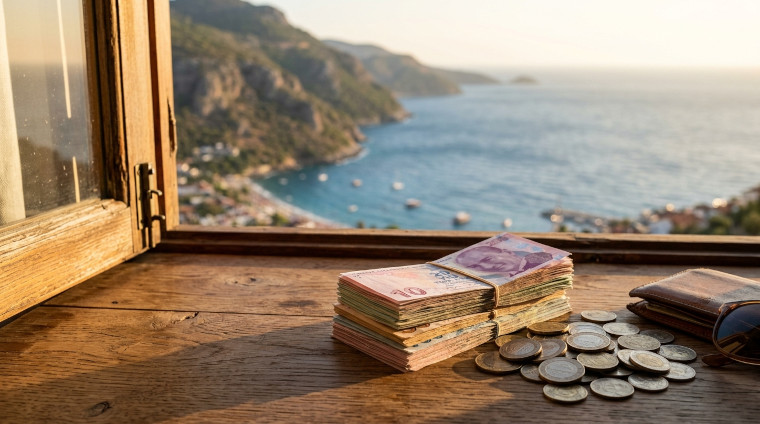
The official currency of Northern Cyprus is the Turkish lira (TRY). It is the only legal tender for all domestic transactions in this territory: salaries, rent, utility bills and most everyday purchases are all calculated in lira.
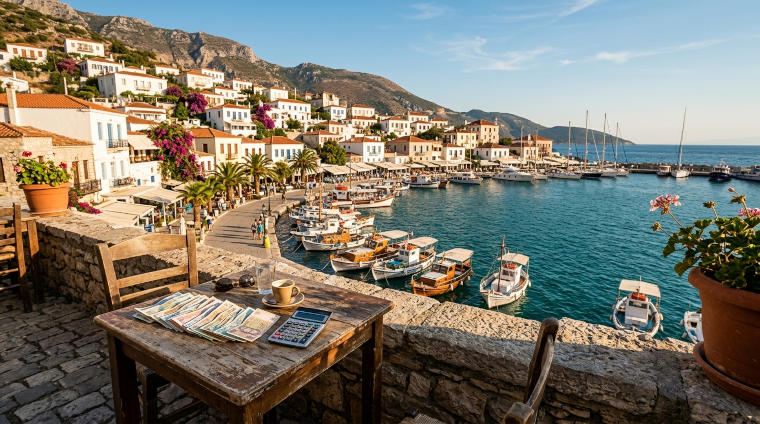
The image was generated using AI technologies
Until 2005, the old Turkish lira, with an enormous number of zeros on its banknotes, was in circulation, which caused confusion even among local residents; after the currency reform, it was replaced by the new lira, which is still used today. So, when you hear about the currency of Northern Cyprus, it is the modern Turkish lira that is meant, rather than some separate Cypriot monetary unit.
Why the official currency is the Turkish lira
To understand why the official currency in Northern Cyprus is the lira, it is worth recalling a little history. In 1974, the island of Cyprus was effectively divided into two parts, and in 1983 the northern part declared itself the Turkish Republic of Northern Cyprus.
A distinctive feature of this territory is that its status as a state is recognised only by Turkey — all other countries in the world consider the north of Cyprus to be part of the Republic of Cyprus. The Turkish lira is used as the local currency. Close political and economic ties with Turkey made the adoption of the lira logical and, in effect, the only possible solution.
There is no separate Cypriot lira or any other independent monetary unit in the north of the island; it is worth knowing this in advance, so as not to waste time before your trip searching for a currency that does not exist.
How it differs from the currency of the Republic of Cyprus (the euro)
The southern and northern parts of the island operate under different monetary systems, and it is important to understand this when planning your route. In the south, in the Republic of Cyprus, which is recognised by the international community and is a member of the European Union, the official currency is the euro. In the north, as we have already established, transactions are made in Turkish lira.
If you plan to cross the border — say, from Nicosia in southern Cyprus to the northern part of the island — be prepared for the currency to change within just a few steps. You cannot pay in euros at a café in southern Cyprus and then cross to the north and spend the same euros there without conversion; prices and transactions in the North are in liras.
A practical tip: if your route includes both parts of the island, take both euros for the south and a small amount of lira for the north with you; this will save you unnecessary exchanges and stress at the border.
How the non-recognition of the TRNC affects finances
Since the Turkish Republic of Northern Cyprus is recognised only by Turkey, the region has no direct access to international financial institutions, has no currency of its own and has limited opportunities for large international banking operations.
This is no cause for alarm: banks and exchange offices in the territory operate reliably, and tourists and residents use cash and cards without serious problems. However, when transferring large sums or opening an account, it is worth bearing in mind the special status of the territory; we will discuss this in more detail in the sections on cards and banking operations.
For now, the main thing to remember is this: the lira is the official and only legal currency for transactions within the republic; in practice, however, the situation in tourist areas is somewhat different — more on that later.
Which Currencies are Accepted in Northern Cyprus
Good news for first-time tourists: it is not only the lira that is accepted for payment on the northern part of the island.
Some hotels, shops and restaurants in tourist areas may accept euros, US dollars or pounds sterling (be sure to check in advance which currencies are accepted for payment and change). This is due to the large flow of holidaymakers from Europe and the United Kingdom, which is why businesses long ago adapted to their payment habits. However, this flexibility has its own nuances, which are important to understand in advance so that you do not overpay.
Euros, dollars and pounds sterling in hotels and shops
Large hotels, tourist shops and restaurants in popular areas of the island almost always list prices in several currencies at once or accept payment depending on which banknotes you hand over. Pounds sterling are particularly widely used, thanks to the large number of British tourists and expats who have long chosen Cyprus. Dollars and euros also rarely surprise a cashier in a tourist shop or a waiter in a seaside restaurant.
An important point: change is almost always given in lira, and the in-house conversion rate at establishments is often less favourable than the official rate at exchange offices or banks.
For example, if the official euro-to-lira rate differs from the one applied by the shop assistant, the in-house conversion rate may be less favourable than at an exchange office or bank; check it before you pay.
Here is a practical tip: before buying, ask for the price in lira, and then compare which is better value — paying in the local currency or in a foreign one. It often turns out that paying in lira is noticeably cheaper than handing over euros or dollars at the establishment’s own rate.
It is also worth remembering that locals in Northern Cyprus almost always use the lira in everyday life — in neighbourhood supermarkets, at markets and in small cafés away from the tourist streets. If you want to pay at a good rate and without surprises, always keep some lira in cash with you, and use foreign currency only where it is convenient and where you have checked the rate in advance.
Can payments be made in roubles
The answer here is clear: roubles are practically not accepted for payment anywhere, and exchanging them on the spot will also be difficult. Acceptance and exchange of roubles on the spot are not guaranteed; check the terms with the exchange office in advance and have an alternative method of payment ready.
Even at large exchange offices in Kyrenia or Famagusta, you are unlikely to find a good rate for the rouble, and outside the tourist centres it is almost impossible to find a place to exchange roubles, which is a real risk of being left without cash at the moment you need it.
Therefore, a sensible strategy is to exchange roubles for euros, dollars or straight into lira before travelling to Cyprus, in your home city or at the departure airport.
An alternative is to use bank cards issued by Russian banks, but it is important to check in advance the limits on cash withdrawals and card acceptance at points of sale, since not all systems work equally reliably. This approach will spare you unnecessary headaches and allow you to manage your funds with ease from the first day of your holiday.
Where and How to Exchange Money at a Good Rate
Compare the final amount you will receive after the exchange at several banks and exchange offices, including commissions and any possible fees. The difference may seem small, but when exchanging a large sum it turns into real money; sometimes it amounts to savings of several thousand lira per trip. Let us look at where to find a good rate and how to avoid overpaying.
Banks and exchange offices in Kyrenia, Famagusta and Nicosia
In the three major cities of Northern Cyprus — Kyrenia (Girne), Famagusta and Nicosia (Lefkoşa) — there are both branches of local banks and private exchange offices. Banks usually charge a commission per transaction and offer a slightly less favourable rate, but they are a stable and predictable option if you’d rather not worry about whom to trust.
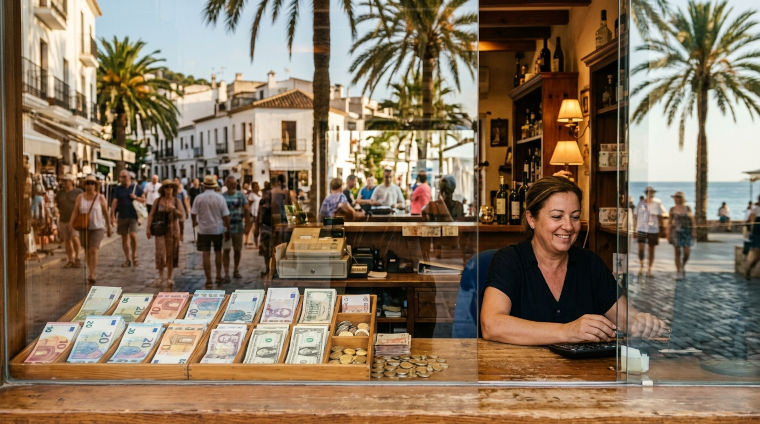
Private exchange offices, which locals simply call ‘currency exchange’, most often operate without any commission at all, and their rates are noticeably more attractive, especially if the office is located in a business district rather than right next to a hotel.
The image was generated using AI technologies
A practical tip: look for exchange offices in the city centre and in shopping areas, rather than at the first places you come across near the beach or a hotel — the rate there is traditionally worse because they are aimed at tourists who will not compare. In Kyrenia, good exchange offices are concentrated around the old harbour and the central shopping streets.
In Famagusta, look for the exchange offices in the city’s business centre. Compare rates and commissions at several exchange offices; how good a deal you get depends on the specific office and the time.
The lira exchange rate and its fluctuations
The Turkish lira is a highly volatile currency, and this is not a one-off situation but a characteristic that has persisted for several years in a row. The TRY rate against the dollar and the euro can change noticeably within just a few days, and what looked like a good rate last week may no longer be relevant by the time of your trip. There is no need to be alarmed; you simply need to treat currency exchange as a process that requires a little preparation.
Before your trip, be sure to check the current value of the lira through official financial websites or banking apps; it will take a couple of minutes and will help you plan your budget more accurately.
How much cash to take with you
As a rough guide, for each day of your stay you should allow an amount that will cover food, transport and small purchases; this is usually enough for a comfortable holiday without unnecessary worry.
It is sensible to bring the bulk of your money in euros or dollars, and then exchange it for lira on the spot at your chosen exchange offices at the current rate. It is worth having a small amount of lira with you immediately on arrival — it should be enough for a taxi from the airport, lunch at a café and your first small expenses, before you have reached a city with good exchange offices.
For larger purchases — car hire, shopping, paying for excursions — it is more convenient to use a bank card, and to keep cash as a reserve for unforeseen situations, such as small shops or markets where cards are not accepted. This approach removes unnecessary anxiety and makes the trip far more predictable financially.
Bank Cards and Cash Machines in Northern Cyprus
Bank cards have long since become a familiar way of paying, and in this respect Northern Cyprus is no different from the popular resorts of Europe. The infrastructure for cashless payments is particularly well developed in the tourist cities — Kyrenia, Famagusta and Nicosia — whereas in the interior of the island and in small Cypriot villages you may not be able to use a card. Let us look at where bank cards work without problems and where it is better to have cash as a back-up.
Paying by card in hotels, restaurants and shops
Some large hotels, supermarkets and restaurants accept Visa and Mastercard, but you should check whether card payment is possible in advance and keep cash with you. There are terminals at hotel receptions, at the tills of shopping centres, in cafés on the Kyrenia waterfront and in popular establishments in Famagusta.
Credit cards of international payment systems work without any hitches, and the payment process itself is no different from what you are used to in any European country, including Southern Cyprus.
The situation is more difficult with small family-run cafés, market stalls and street traders — there, card payment is most often simply not technically available, only cash in lira. This applies particularly to the eastern markets and small snack bars off the tourist streets.
Our advice: keep a small amount of cash in lira with you each day; it should be enough for lunch at an authentic Cypriot café or for buying fruit at a market, where paying by card is simply not possible.
Withdrawing cash from cash machines
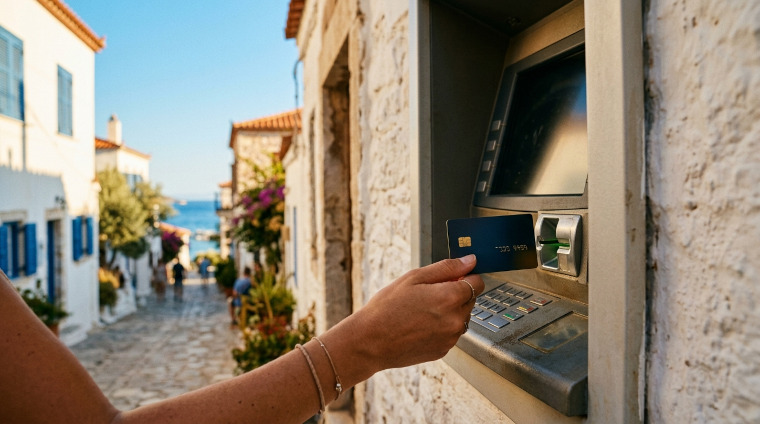
Cash machines of international and local banks are widely available in Kyrenia, Famagusta, Nicosia and right at the airport; finding somewhere to withdraw cash will not be difficult even on your first day in Cyprus. Whether you can withdraw cash with a foreign card depends on the issuing bank, the payment system and the specific cash machine; check the terms in advance and have a back-up method of payment.
An important point is fees. The local bank that owns the cash machine may charge a fee, and so may the bank that issued your card. As a result, you could end up facing two types of charges for a single transaction.
The local bank’s fee is usually a fixed amount in lira or a percentage of the amount withdrawn, and the issuing bank additionally charges a percentage for currency conversion. You should also take into account the limit on withdrawals per transaction — usually a few hundred or a couple of thousand lira, depending on the cash machine.
The image was generated using AI technologies
To avoid overpaying for repeated transactions, it is more sensible to withdraw a larger sum at once, covering your expenses for several days of your stay in Cyprus, rather than running to the cash machine every day for small amounts. This will reduce the number of fees and save you money.
Before you fly, be sure to check with your bank the terms of using your card abroad: the size of the withdrawal fee, the conversion rate and any restrictions on transactions in the Northern Cyprus region. This simple check will take five minutes but will save you much more and spare you unpleasant surprises on your bank statement after your holiday in Cyprus.
Practical Tips for Tourists and Property Buyers
Each category of reader faces its own money questions in Northern Cyprus, and it is sensible to prepare for them in advance rather than working things out on the spot by trial and error. Below are specific recommendations for tourists, property buyers and those planning to relocate, bearing in mind that the lira remains a volatile currency and requires a well-thought-out financial plan.
Payments when buying property in Northern Cyprus
The currency of the price and payments when buying property depends on the terms of the specific transaction; make sure to check it, and the payment procedure, in the contract before signing. The reason is simple: the Turkish lira is too unstable for long-term obligations, and a property transaction stretches over months, sometimes years, if you are buying at the construction stage.
The sale and purchase agreement usually fixes the price in a stable foreign currency; this protects the buyer from sharp exchange rate fluctuations and makes it possible to plan the budget accurately, without the risk that the flat will suddenly become more expensive because of a jump in the lira.
Before signing any papers, be sure to check with the developer or estate agency which currency the contract will be concluded in and which currency you will need to make the scheduled payments in. This removes most of the risks and spares you unpleasant surprises at the final stage of the transaction.
Budget and currency for tourists before the trip
Before your trip, it is worth working out your overall budget in advance and dividing it into three parts: cash in lira for your first expenses, a reserve in euros or dollars to exchange on the spot, and a bank card for larger spending. As a rough guide, for a week’s holiday, an amount covering food, transport and small purchases is enough, and it is more convenient to keep the rest on your card.
The image was generated using AI technologies
Financial advice for relocators on the island
For those moving to live on the island, it is important to consider opening an account with a local bank; this can usually be done in lira, euros or dollars simultaneously. It is better to transfer large savings gradually rather than as a single sum, in order to reduce the risk of losses due to lira inflation.
A final checklist before your trip or relocation:
Check the contract currency when buying property.
Check the current lira exchange rate.
Take some cash in lira and a reserve in euros or dollars.
Check the terms for your card and cash machine use with your bank.
Plan how to transfer your savings when relocating.
Frequently Asked Questions
What currency is used in Northern Cyprus in 2026?
The currency of Northern Cyprus is the Turkish lira, and it is the only legal tender throughout the territory of the TRNC. There is no separate Cypriot monetary unit there, and there never will be, because the region uses Turkey’s financial system. In tourist areas, payment in euros, dollars or pounds is acceptable, but the basis of transactions is the lira. Use it as your guide when planning your travel budget.
Can you pay in euros in Northern Cyprus?
Yes, in many hotels, restaurants and shops in tourist towns, euros are accepted without any problems. However, it is better value to pay in lira, because the sellers’ internal conversion rate is often worse than the official one by five to ten per cent. Change is almost always given in lira, so small amounts of cash in the local currency will come in handy in any case. Keep euros for larger purchases, and carry lira for everyday expenses.
Is it worth buying Turkish lira in advance in Russia?
There is usually no point in buying lira in advance in Russia: for this type of transaction, the rate at local exchange offices in Northern Cyprus is usually better, while finding lira at Russian banks can be difficult because of the low demand for this currency.
It is more sensible to take euros or dollars with you and exchange them on the spot at reliable offices in Kyrenia, Famagusta or Nicosia. This approach reduces the risk of losses at an unfavourable rate and gives you more flexibility in choosing how to pay. You can buy a small amount of lira at the arrival airport for your first expenses.
Do Visa and Mastercard cards work in Northern Cyprus?
Some hotels, supermarkets and restaurants accept Visa and Mastercard, but the terms depend on the establishment and the bank; before your trip, check whether payment and cash withdrawal are possible. Cash machines accept these cards for withdrawing lira almost everywhere, including at the airport, and this is the most convenient way for visitors to access the local currency.
The only caveat is the fees charged by the issuing bank and the local bank, which together can noticeably affect the final amount you withdraw. Check the terms of using your card abroad with your bank before your trip to avoid unpleasant surprises on your bank statement.
Article header image was generated using AI technologies
What a free economic zone in Dubai is. Overview of Dubai's key free economic zones. How to choose a free economic zone for your business. Registering a company in a free economic zone: process, taxes,...
The best entertainment for families with children. Free entertainment in Dubai. Dubai's iconic landmarks and attractions. Practical tips for budget-conscious travellers. Frequently asked questions.
The essence of the conflict in the Middle East. When the situation with flights to Dubai returned to normal. Current situation with flights to Dubai. What to expect by late October 2026. Is it safe to...
Ain Dubai — a record-breaking Ferris wheel. Location and directions to Ain Dubai. Ride experience and what can be seen. Practical information for visitors. Frequently asked questions.
Why Arabic is not a single language. How Arabic dialects arose — a brief history. The main groups of Arabic dialects — where they are spoken and how. Do Arabs from different countries understand one a...


 The image was generated using AI technologies

 The image was generated using AI technologies

 The image was generated using AI technologies

 The image was generated using AI technologies