Home/Middle East/Nature of Saudi Arabia: Climate, Resources, and Natural Landmarks
23.07.2026
Middle East
1034
Reading time: 13 minutes
Nature of Saudi Arabia: Climate, Resources, and Natural Landmarks
Save the article:
What natural secrets does the Arabian Peninsula hold, and why is so little known about them? The nature of Saudi Arabia is not just endless sand, as many assume — it's a complex system of ecosystems that brings together deserts, mountain ranges, Red Sea coral reefs, and fertile oases. The kingdom's territory covers most of the Arabian Peninsula and borders Yemen, Oman, the UAE, and Jordan, creating a unique diversity of landscapes and climate zones. Many travelers planning a trip wonder which natural landmarks of Saudi Arabia are worth seeing first — from the mountains of the Asir region in the southwest to the sand dunes of the country's central area. Students working on research papers often struggle to find structured data on Saudi Arabia's natural resources, including oil, water, and mineral reserves that shape the region's economy. Researchers and specialists in geography and ecology look for up-to-date information on how the climate and nature of Saudi Arabia are changing under the influence of global warming, and what this means for flora, fauna, and local communities.
What will you gain from reading this material? The article gathers key facts about the distinctive features of Saudi Arabia's nature: from temperature records and seasonal rains to rare animal species, such as the Arabian oryx and the sand gazelle, that live in the country's nature reserves. You'll learn which mountain systems and coastal zones shape the diversity of terrain, why the Rub' al Khali desert is considered one of the largest in the world, and what practical tips can help you plan a safe trip at different times of the year. This material will be useful both for those preparing academic work and for anyone who simply wants to learn more about the region's nature before traveling, so next we'll take a detailed look at the climate zones, flora, fauna, and main natural attractions of Saudi Arabia.
Natural Features of Saudi Arabia: Geography and Terrain
Saudi Arabia occupies most of the Arabian Peninsula and lies in the southwestern part of West Asia, at the crossroads of Africa, Asia, and Europe. This position historically turned the country into a hub of trade routes and climate zones.
Saudi Arabia's territory covers more than 2,000,000 square kilometers, making the kingdom the largest state in the region. At the same time, there is not a single permanent river anywhere on the country's map — a unique feature of Saudi Arabia's nature that sets it apart from most major countries in the world.
The image was generated using AI technologies
The kingdom borders six countries: Yemen to the south, Oman to the southeast, the United Arab Emirates, Qatar, and Bahrain (via the Persian Gulf) to the east, and Jordan, Iraq, and Kuwait to the north.
Its coastline is washed by two seas: the Red Sea in the west and the waters of the Persian Gulf in the east. This location between the two seas shapes the diversity of landscapes and serves as a natural boundary between the country's internal natural zones.
Deserts and Sandy Landscapes
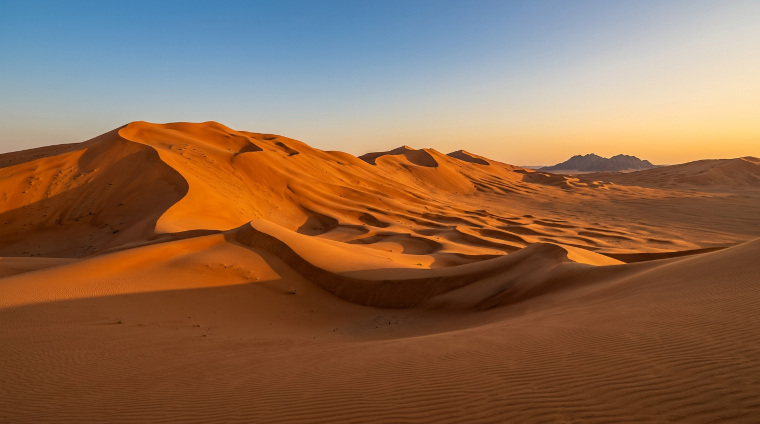
Nearly a quarter of Saudi Arabia's terrain consists of several deserts. The largest of these, Rub' al Khali ("the Empty Quarter"), covers the southeastern part of the country and is considered one of the driest places on the planet: rainfall is almost nonexistent there, and dune heights reach 250 meters.
To the north lies the Nafud desert, known for its reddish sands, which owe their hue to the high content of iron oxide.
To grasp the scale of the desert territories, it's worth noting a few key features:
dunes form under the influence of constant winds and can "migrate" dozens of meters per year;
temperature swings between day and night in the deserts reach 30–40 degrees;
ancient riverbeds that existed thousands of years ago, during wetter geological eras, lie hidden beneath the sands.
Mountain Ranges and the Country's Highest Point
The western part of Saudi Arabia looks markedly different from the desert plains, as it is dominated by the Hejaz and Asir mountain ranges, which run parallel to the Red Sea coast.
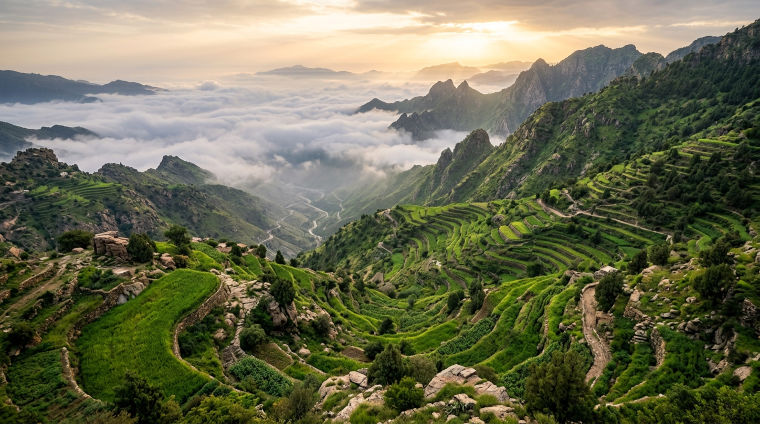
The Hejaz is known as the country's spiritual center; it's in its foothills that the holy cities of Mecca and Medina are located. The Asir Mountains, further south, feature a more humid climate and terraced agriculture that has survived since ancient times.
It is in the Asir range that the country's highest point is found — Jabal Sawda, rising more than 3,000 meters above sea level. Thanks to its elevation, a distinct microclimate forms there: summer temperatures are noticeably lower than in the rest of Saudi Arabia, and winter can bring fog and even frost.
Wadis Instead of Rivers
The absence of permanent waterways is compensated by a system of wadis — dry riverbeds that fill with water only during seasonal rains. Wadis can be compared to natural drainage channels: for most of the year they're dusty paths among rocks, but after heavy rain they turn into raging torrents.
For tourists and locals alike, wadis pose a hidden danger — flash floods can catch off guard anyone who has set up camp in a dry riverbed.
Division into Natural Zones
The territory of Saudi Arabia is traditionally divided into several major natural zones:
the western zone — the Red Sea coastal strip with coral reefs and mountain ranges;
the eastern zone — the low-lying Persian Gulf coast with oil fields and salt flats;
the central zone — the Najd plateau, the kingdom's historic heartland, with tablelands and scattered oases;
the southern and northern zones — transitional territories with the Rub' al Khali and Nafud deserts, respectively.
This zoning explains why the nature of Saudi Arabia is so varied: coral reefs, lifeless dunes, and cool mountain plateaus all exist within a single country. It helps to picture this structure as a physical map with color-coded elevations: from dark green coastal lowlands to the brown mountain peaks of Asir.
Climate and Nature of Saudi Arabia by Region
The climate and nature of Saudi Arabia form a single system in which terrain directly shapes temperature patterns and rainfall levels. Most of the kingdom lies within a tropical desert climate zone, while a narrow strip in the west, along the Red Sea coast and in the Asir Mountains, leans toward a subtropical climate with more pronounced seasonality.
This diversity stems from the country's vast size and elevation differences — from coastal lowlands to mountain peaks exceeding 3,000 meters.
Seasonal Climate Features
The year in Saudi Arabia is divided into two sharply contrasting periods: a scorching summer and a relatively mild winter.
From June to September, daytime air temperatures exceed 45°C almost everywhere, and in the central and eastern regions the thermometer often climbs to 50°C. Humidity during this period is low, rainfall is virtually nonexistent, and the scorching air creates an oven-like effect even at night.
The winter period, spanning December through March, brings noticeable relief. Daytime temperatures hover around 18–25°C, though at night — especially in January — the air can cool to 5–10°C, and in mountainous areas, even below freezing. Most of the year's rainfall falls in winter, though in absolute terms the amount is modest: 50 to 150 mm per year, depending on the region.
In spring, during March and April, the country experiences a brief transitional season: temperatures gradually rise, and rare but intense downpours can trigger short-lived flash floods in the dry riverbeds known as wadis. By May, the heat is already building, signaling the approach of summer scorch, and by October it gradually recedes, bringing back comfortable conditions for walks and excursions.
Climate Zones: From Mountainous Asir to the Central Desert
The country's climate and nature vary noticeably depending on the region's geographic location. The territory can be roughly divided into three major climate zones.
Region
Climate Features
Average Summer Temperature
Asir Mountains
Mild subtropical climate, monsoon rains possible in summer
25–30 °C
Coastal areas (Red Sea and Persian Gulf)
High humidity, strong evaporation, and a stifling feel
35–42 °C
Central desert zone (Najd, Rub' al Khali)
Dry air and sharp daily temperature swings
45–50 °C during the day, down to 15 °C at night
The Asir mountain range in the southwest stands out for its cool, humid climate, owing to its elevation and proximity to the sea: rain falls regularly there in summer, and temperatures rarely exceed 30°C, making the region a kind of green oasis amid the deserts.
The coastal zones of the Red Sea and the Persian Gulf are characterised by elevated humidity, which makes the heat feel harsher than in the dry central region, even at lower thermometer readings.
The country's central part, including the Rub' al Khali desert, displays a classic desert climate with minimal humidity and enormous temperature swings: during the day the sand heats up to extreme levels, and at night it cools quickly due to the absence of clouds and vegetation that would otherwise retain heat.
Practical Tips for Travelers
To make a trip to Saudi Arabia comfortable, it's important to choose the right season and prepare for the region's climate.
The best time to visit is from October to April, when daytime temperatures rarely exceed 30°C.
For visiting the mountainous Asir region, summer months are ideal, since the central regions suffer unbearable heat while the mountains stay cool and the slopes turn green.
During winter (December–January), pack warm clothing for evening walks, as nighttime temperatures can drop to 5°C.
In spring (March–April), keep an eye on rain forecasts, since downpours can temporarily flood roads in wadi areas.
In summer (June–September), sunscreen, headwear, and a large water supply are essential, especially when traveling to the central desert zone.
Understanding the climate features of each region not only helps in planning a route, but also gives a deeper appreciation of the uniqueness of Saudi Arabia's natural landscapes — from cool mountain valleys to scorching seas of sand.
Natural Resources of Saudi Arabia and Their Use
Saudi Arabia's natural resources formed millions of years ago, when the territory of the modern kingdom was the floor of an ancient sea.
Sedimentary rocks lying beneath the rocky plateaus of the eastern part of the country created unique geological conditions for the accumulation of hydrocarbons, while the crystalline rocks of the Arabian Shield in the west became the basis for ore deposits.
It's precisely this combination of sedimentary cover and ancient bedrock that shaped the country's economic specialization for decades to come.
The Oil and Gas Complex: The Foundation of the Kingdom's Economy
Saudi Arabia holds some of the largest proven oil reserves in the world, by various estimates, exceeding 258 billion barrels, roughly 17% of global reserves.
The state company Saudi Aramco, the world's largest oil producer, extracts more than 9 million barrels per day. In addition to oil, the country holds substantial natural gas reserves — around 8.2 trillion cubic meters, placing it among the world's top ten gas-producing nations.
Key fields are concentrated in the kingdom's Eastern Province:
Ghawar — the world's largest oil field, in production since 1948;
Safaniya — the largest offshore oil field;
Khurais and Manifa — strategic reserve production sites.
The oil and gas sector traditionally accounts for more than 40% of the country's GDP and around 70% of export revenue, making Saudi Arabia's economy one of the most hydrocarbon-dependent in the world.
Gold and Other Minerals
Beyond hydrocarbons, the country's subsoil is also rich in solid minerals. Gold mining takes place mainly in the Mahd Al Dhahab area — a historic deposit known since the time of the Queen of Sheba.
Modern technology has boosted precious metal production to 40 tons a year, making Saudi Arabia a notable player in the regional gold mining market.
Geologists have also identified significant reserves of:
phosphates — used to produce fertilizers;
bauxite — raw material for the aluminum industry;
copper, zinc, and iron ore in the mountainous areas of the country's western region.
According to estimates from the kingdom's geological survey, the total value of undeveloped mineral resources exceeds $1.3 trillion, opening up major prospects for the mining industry.
Water Resources and the Role of Seawater Desalination
Limited water resources are one of the region's key natural characteristics. The country has no permanent rivers, and underground aquifers replenish extremely slowly due to scant rainfall. Under these conditions, seawater desalination has become a vital technology for supplying the population with drinking water.
Saudi Arabia ranks first in the world for desalinated water output: more than 5.6 million cubic meters a day are produced at plants along the Persian Gulf and Red Sea coasts. Cities' dependence on desalination plants reaches 70%, making this industry as strategically important as oil production.
Diversifying the Economy: The Vision 2030 Program
Aware of the risks of relying too heavily on hydrocarbons, the kingdom's leadership is carrying out a large-scale program of structural reforms. Key directions of diversification include:
developing the mining industry as a third pillar of the economy, alongside oil and petrochemicals;
investing in renewable energy sources — solar and wind power plants;
modernizing desalination technology using energy-efficient membrane systems;
attracting foreign investment into non-oil sectors.
The program's target is to raise the share of non-oil revenue in GDP to 50% by 2030, which will significantly reshape the economy's structure and reduce reliance on Saudi Arabia's natural resources as the country's sole source of prosperity.
Natural Landmarks of Saudi Arabia and Tourist Locations
The natural landmarks of Saudi Arabia form a true open-air museum, where geological processes spanning millions of years exist alongside modern tourist routes.
The country has more than fifteen protected natural areas, each showcasing its own unique scenery — from volcanic fields to coral gardens. For tourists and researchers alike, this offers a rare chance to see how the ecosystems of the Arabian desert have adapted to extreme conditions while preserving biological diversity.
Reserves and National Parks
The kingdom's system of protected areas has been developing since the 1980s under the oversight of the National Center for Wildlife. Notable reserves include the Farasan Islands, with mangrove groves and colonies of seabirds; Uruq Bani Ma'arid, on the edge of the Rub' al Khali, home to the oryx and the dorcas gazelle; and the Ibex Reserve, with mountain goats on rocky plateaus.
These zones harbor rare endemic plant species found nowhere else, as well as traces of ancient caravan routes carved into stone thousands of years ago.
Unique geological sites, such as the Al-Wahbah Crater, about two kilometers in diameter and more than two hundred meters deep, formed by a volcanic explosion, deserve special attention. In the eastern provinces, you can find the striking rock formations of AlUla, including the famous Elephant Rock, resembling the silhouette of an elephant.
The oases of Al-Hasa and Tabuk stand as living proof of how underground water sustains date palms and agriculture amid an arid landscape — the largest of them, Al-Hasa, is a UNESCO-listed site and contains more than two and a half million palm trees.
The Asir Region and the City of Roses, Taif
The mountainous Asir region in the country's southwest differs strikingly from the desert territories: rainfall is recorded there in summer, and juniper forests and blooming terraces grow on the slopes. Asir National Park, spread across elevations of up to three thousand meters, offers tourists mountain trails, cable cars, and views of clouds below the observation platforms.
Nearby is Taif, known as the city of roses thanks to its Damask rose plantations, whose petals are used to produce the famous rose oil; an annual festival held there draws thousands of visitors.
The image was generated using AI technologies
The Red Sea Coast and Diving
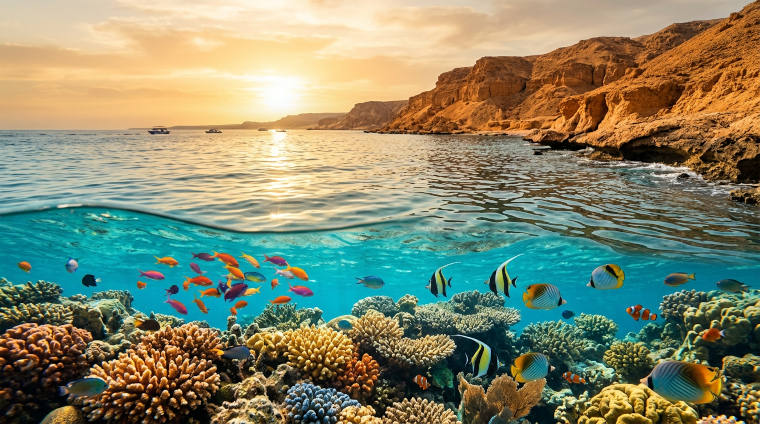
The Red Sea along the western coast is renowned for having some of the cleanest coral reefs on the planet, home to more than two hundred coral species and over a thousand fish species.
Popular diving and snorkeling spots are located near Jeddah, Yanbu, and the Farasan Islands, where water clarity allows visibility of the seabed down to thirty meters. Local dive centers organize tours to the reefs, offering both single-day dives and multi-day expeditions to sunken shipwrecks.
The Rub' al Khali Desert for Safaris
Rub' al Khali, the world's largest sand desert, covering roughly 650,000 square kilometers, has become a magnet for extreme tourism enthusiasts. Jeep safaris, overnight stays in open-air camps, and stargazing far from city light pollution are offered there.
Practical Recommendations for Travelers
Before your trip, consider a few factors that affect comfort and safety when visiting natural sites:
The best time to visit is from November to March, when daytime temperatures are comfortable for walking and safaris.
For Red Sea diving, the ideal months are May through October, when underwater visibility is at its best.
When visiting the Asir Mountains, pack warm clothing, since nighttime temperatures can drop below ten degrees.
For desert excursions, sunscreen, headwear, and a water supply of at least three liters per person per day are essential.
Most locations can be reached via the airports of Jeddah, Abha, and Tabuk, followed by renting a car or booking an organized tour.
Flora and Fauna of Saudi Arabia: Rare Species and Ecosystems
The nature of Saudi Arabia showcases the remarkable ability of living organisms to adapt to extreme conditions, such as temperature swings, water scarcity, and poor soils.
The distinctive features of Saudi Arabia's flora and fauna reveal themselves precisely through this adaptation: plants and animals have learned to survive where life would seem impossible.
Biologists estimate that the kingdom is home to more than 2,250 plant species and over 450 vertebrate species, some of which are found only on the Arabian Peninsula.
Plant Life of Oases and Deserts
Date palms remain the backbone of vegetation in the oases — a crop that has fed the local population for thousands of years. Today the country has more than 30 million palm trees and over 300 date varieties, which yield fruit even at summer temperatures above 45 degrees.
Alongside palms, the acacia plays an important role — a tree with a deep root system capable of drawing moisture from several meters underground. Acacias form a kind of framework for desert ecosystems, providing shade and shelter for small animals and birds.
In the mountainous areas of Asir, juniper and wild olive trees can be found, while mangrove groves along the Red Sea coast support coastal wildlife.
Wild Desert Animals: Key Species
The fauna of Saudi Arabia's deserts evolved under intense natural selection, and each species demonstrates unique survival mechanisms.
The gazelle — a fast, hardy animal able to go without water for several days, drawing moisture from plants.
The Arabian oryx — a symbol of the region's desert fauna, nearly extinct in the wild by the 1970s and restored through breeding programs.
The Nubian ibex — an inhabitant of rocky massifs, adapted for moving across steep slopes thanks to specially structured hooves.
The caracal — a desert lynx with characteristic ear tufts, active at night.
Jackals, foxes, and wolves — mid-sized predators that act as natural regulators of rodent and small ungulate populations.
Beyond mammals, the country is home to more than 450 bird species, including falcons and vultures, traditionally tied to Bedouin hunting culture.
Protecting Rare Species and the Role of Nature Reserves
Biodiversity conservation measures in the kingdom have notably intensified in recent decades. The National Center for Wildlife runs reintroduction programs, returning species on the brink of extinction to their natural habitats.
The Al-Khunfah Reserve and the Ibex Reserve have become sites where the Arabian oryx and Nubian ibex are rebuilding their populations under specialist supervision. In this context, Saudi Arabia's natural resources include not just minerals, but also the genetic diversity of wild species, viewed as a strategic asset for future generations.
According to official data, protected natural areas cover more than 17% of the country's land, placing the kingdom among regional leaders in the pace of establishing protected zones.
Potentially Dangerous Desert Inhabitants
Tourists planning routes through desert areas should be aware of a few potentially dangerous species. These include scorpions, whose sting can cause intense pain and allergic reactions, as well as several venomous snake species, including the horned viper, which camouflages itself in the sand.
Wolves and caracals avoid humans and pose a risk only through direct contact, so the main recommendation is to avoid approaching wild animals and to carefully check footwear and gear before use after camping overnight in the desert.
Frequently Asked Questions
Is Saudi Arabia's nature just desert?
No, that's a common misconception. Saudi Arabia's natural landscape is much more than just sandy plains: in the west, the Hejaz and Asir mountains rise more than 2,000 meters, coral reefs line the Red Sea coast, and date palms and other greenery grow in the oases.
The image was generated using AI technologies
Deserts cover about half the country's territory, but the climate and nature of Saudi Arabia create diverse landscapes, from rocky plateaus to mountain wadi valleys. This combination makes the country appealing not only to fans of sand dunes, but also to those seeking mountains and seascapes.
What is the country's highest point?
Saudi Arabia's highest point is Jabal Sawda in the Asir region, standing at about 3,015 meters above sea level. This peak is part of a mountain range in the southwest of the country, where the climate is significantly cooler than in the central and eastern regions.
Its elevation supports distinctive vegetation, including forests and meadows uncommon elsewhere in the kingdom. The Asir region is popular with tourists precisely because of this contrast with the desert zones.
When is the best time to visit Saudi Arabia based on climate?
The best time to travel is from November to March, when air temperatures are comfortable for exploring most regions of the country. In summer, especially June and July, daytime temperatures in the central and eastern regions can exceed 45 degrees, making prolonged outdoor activity difficult.
In spring, during March and April, plants bloom in the Asir Mountains, while the Red Sea coast remains pleasant for relaxation nearly year-round. When planning a trip, it's worth considering not just the month but the specific region, since the climate varies significantly.
What natural resources does the country have besides oil?
Natural resources of Saudi Arabia aren't limited to hydrocarbons; the country mines gold, silver, copper, and phosphates, and also produces construction materials from limestone and gypsum.
Underground water in the oases is used for agriculture, and solar energy is becoming an increasingly important resource for new projects. The Red Sea provides fish and other seafood for local communities. This resource diversity helps the country diversify its economy.
What animals live in the deserts of Arabia?
The deserts of Saudi Arabia are home to the Arabian oryx, sand gazelle, caracal, fox, and jackal, all of which have adapted to life in heat and water scarcity. The Arabian wolf also remains part of the local fauna, though its numbers have declined noticeably in recent decades.
Many species are nocturnal, avoiding the heat of the day. These animals symbolize the resilience of wildlife to extreme desert conditions.
Can you see coral reefs in Saudi Arabia?
Yes, the Red Sea coast is known for some of the best-preserved coral reefs in the world, accessible for diving and snorkeling. Clear waters and rich marine flora and fauna attract tourists and researchers from around the globe.
The reefs stretch along the entire western coast, including areas near Jeddah and the surrounding islands. This part of the marine ecosystem complements Saudi Arabia's natural landmarks and makes the country appealing not only to desert enthusiasts, but also to fans of the underwater world.
Article header image was generated using AI technologies
Where to buy a car in Dubai? Car registration and ownership costs in Dubai. Fines and driving rules in Dubai. Car rental in Dubai. Frequently asked questions about cars in Dubai.
What was before the beginning of the history of the UAE? Territories of the UAE in the 19th century. History of economic development of the UAE. The scandalous story of the UAE emir. Top 5 interesting...
Main features of Sharjah City Centre. What’s for sale at Sharjah City Centre? Entertainment for children at Sharjah City Centre. Restaurants at Sharjah City Centre. Cultural events at Sharjah City Cen...
UAE Banking System. Reasons to open a bank account in the UAE. Best UAE banks for opening accounts. Types of accounts offered by UAE banks. How to open a personal account in the UAE? How to open a cor...
Taxes in Dubai are among the lowest in the world. In some cases, individuals and businesses don't pay them at all, while in others, they pay no more than 9% on profits, which is significantly lower th...
General information about alcohol consumption rules in Dubai. Alcohol-related fines in Dubai. Places where you can buy alcohol in Dubai. Popular restaurants and nightclubs in Dubai licensed to sell al...



 The image was generated using AI technologies


 The image was generated using AI technologies


 The image was generated using AI technologies