Home/Middle East/Qatar: What to See — A Guide to the Main Attractions
13.08.2026
Middle East
1156
Reading time: 13 minutes
Qatar: What to See — A Guide to the Main Attractions
Save the article:
What problem did you face when planning a visit to Doha? Some travellers have just 8 hours between flights, whilst others have come for a week and don't know where to begin. Qatar is one of the wealthiest countries in the Middle East, and that is not merely a pretty phrase from a guidebook: the skyscrapers of West Bay, the futuristic museums, and the man-made islands were all built on oil and gas revenues over the last thirty years alone. For tourists, this means a high standard of service, excellent transport links, and attractions found nowhere else in the region.
The question of what to see in Qatar is particularly pressing for those visiting the Arab world for the first time and wanting to make the most of their time without getting lost in an unfamiliar culture.
How will this article help those already packing their bags?The article brings together reference points: how many hours each attraction requires, how to get there from the airport, what dress code is appropriate at mosques and museums, and where to find the best photographs. We shall cover ready-made itineraries — both for a short transit stopover and for a full trip lasting several days — so that a stay in Doha goes smoothly and according to plan.
Qatar: Essential Facts Before Your Trip
Qatar occupies a small peninsula jutting into the Persian Gulf and borders only Saudi Arabia. The capital of Qatar is Doha, which is home to the country's administrative and business centres; the population of Qatar exceeds 3 million people, with Qataris forming a minority and a significant proportion of residents being migrant workers.
Qatar's economy is built on the extraction of oil and, especially, natural gas: the country is one of the world's largest exporters of liquefied gas, which is what has enabled a desert peninsula to become a state with one of the highest per capita incomes in the world.
Local residents enjoy free healthcare, free education, and tax benefits, and the standard of living there is among the highest in the Middle East and across the entire Arab region.
It's worth knowing at least a basic understanding of Qatar's history to understand the rationale behind Doha's museums and architecture. For centuries the peninsula lived off pearl diving and fishing, and the country gained independence from Britain in 1971.
The image was generated using AI technologies
The real turning point came with the discovery of gas fields — it was then that the rapid growth began which tourists see today in the form of West Bay's skyscrapers and Doha's artificial islands.
The FIFA World Cup gave an additional boost to the development of tourist infrastructure: new stadiums were built for the tournament, the metro was expanded, and dozens of hotels opened in Doha — all of which are now used by ordinary travellers.
For those interested in Arab culture, Qatar and its attractions offer a rare combination: traditional souq markets and Doha's museums with world-class collections of Islamic and Arab art.
When is the best time to visit Qatar
Summer in Qatar is a challenging time: temperatures frequently exceed 40°C, and the high humidity intensifies the heat. Walking around the streets of Doha, visiting a souq, or climbing to observation decks with views over the city during this period is almost impossible without the risk of heatstroke.
The comfortable season runs from November to April, when temperatures remain around 20–28°C — ideal conditions both for relaxing on the beach and for actively exploring the sights of Doha. Rainfall in Qatar is rare, and there is virtually no distinct rainy season, so the climate will not disrupt your plans.
The optimal time to visit is from December to February, when the heat subsides most fully and it is possible to spend the entire day outdoors without discomfort, enjoying the view of the Doha waterfront.
Visa, money, and how to get there
Citizens of Russia may be eligible for visa-free entry to Qatar for up to 30 days for short trips; it is worth checking the current entry requirements before travelling, but usually a valid international passport is sufficient. The national currency is the Qatari riyal, the rate of which is pegged firmly to the US dollar, making prices predictable from year to year. Cards are accepted almost everywhere, but cash will come in useful at markets and when paying for a taxi.
Qatar Airways operates direct flights to Doha from Moscow, with a flight time of around 5 hours. Many travellers make use of a long layover in Doha to combine their flight with a brief introduction to the capital of this Arab state and to enjoy a bird's-eye view of the city.
Tickets and travel documents for Doha are best arranged in advance, particularly during the high season, when the flow of visitors to Qatar's capital increases.
Cultural considerations and dress code
Qatar is a Muslim Arab country with a predominantly Arab population, and local residents observe conservative Arab traditions. In public places in Doha, men are advised not to wear shorts above the knee, whilst women should not wear clothes with bare shoulders and short skirts; when visiting mosques, a modest, covered outfit and a headscarf for women are obligatory.
Rules regarding the sale and consumption of alcohol in Qatar are strict and depend on licensed venues; it is advisable to check the current restrictions before travelling.
Bring light clothing with long sleeves and trousers or a skirt below the knee — this is a universally appropriate choice for museums, mosques, and the streets of Doha. Serious violations of local laws and codes of conduct are subject to fines, so respecting the customs of this Arab country is the key to a trouble-free visit in any year.
What to See in Doha: The Main Attractions
Doha is a city where, quite literally within a single day, one can witness Qatar's entire journey from fishing village to one of the wealthiest states in the world. In this city, the glass skyscrapers of West Bay, designed by famous architects, stand alongside the narrow alleyways of traditional quarters, where spices are still sold much as they were a century ago.
The question of what to see in Qatar most often comes down to the capital itself: the National Museum, the Museum of Islamic Art, Souq Waqif market, the Corniche, the artificial island of the Pearl-Qatar, the modern Msheireb district, and the Cultural Village together make up a compact Doha itinerary that can realistically be covered in 2–3 days, with an abridged version possible even during a single long layover in Doha.
To better appreciate the scale and architectural contrast of this part of Qatar, it is worth looking at photos of Qatar's attractions beforehand — the contrast between Doha's futuristic museums and the adobe façades of the old city is more striking than any description.
The National Museum of Qatar
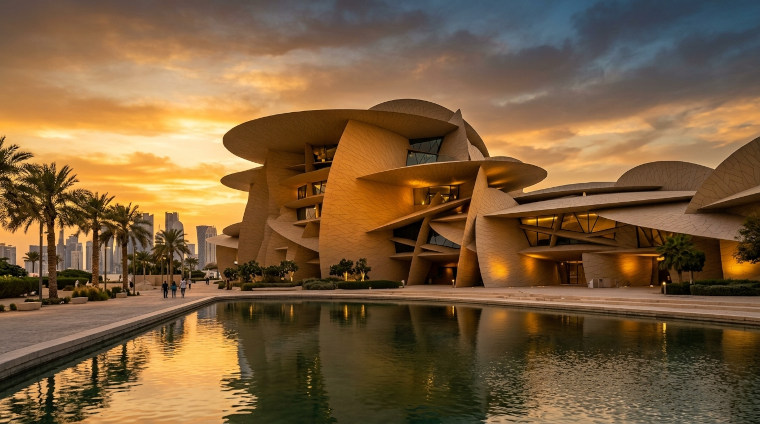
The building of the National Museum of Qatar is a work of art in itself. It was designed by the French architect Jean Nouvel, who drew inspiration from the shape of a mineral that forms in the desert from crystals of gypsum and sand. The architect assembled the building from dozens of interlocking discs of varying diameters, which is precisely how a desert rose looks when enlarged.
The image was generated using AI technologies
Inside the museum, the exhibits tell the story of Qatar in sequential order: from the life of the Bedouins and pearl diving to the discovery of oil and the rapid modernisation of recent decades. The most striking section of the exhibition is the multimedia installations with projections of desert landscapes and sounds that recreate the atmosphere of Qatar's past.
The National Museum is located on the Corniche waterfront, not far from the centre of the city; it can be reached by taxi or by metro to the National Museum of Qatar station. Opening hours are 9:00 AM–7:00 PM, with the museum opening later on Fridays, at around 1:30 PM. The admission fee for adult foreign tourists is approximately 50 Qatari riyals; children under 16 enter free of charge. A thorough visit to this attraction warrants 2–3 hours.
The Museum of Islamic Art
This museum is often described as the main cultural landmark of Doha. The collection brings together works of art from the Islamic world across different eras and regions, from Spain to India: manuscripts, ceramics, textiles, jewellery, and decorative arts.
The building stands on an artificial peninsula specially reclaimed from the bay so that the museum is surrounded by water on all sides and nothing distracts from the geometrically austere forms of its architecture. The project was designed by the architect I. M. Pei, known for his minimalist style with an emphasis on light and geometry.
The Museum of Islamic Art is situated not far from Souq Waqif; on foot along the waterfront the journey takes approximately 10–15 minutes. It is open Tuesday to Sunday from 9:00 AM to 7:00 PM, on Fridays from 1:30 PM; Monday is a day off. Entry to the permanent exhibition is free; temporary exhibitions may be ticketed.
It is worth setting aside 1.5–2 hours to explore the galleries, and afterwards you should go up to the terrace behind the building, as one of the finest panoramic views of Doha bay and the West Bay skyscrapers opens up from there.
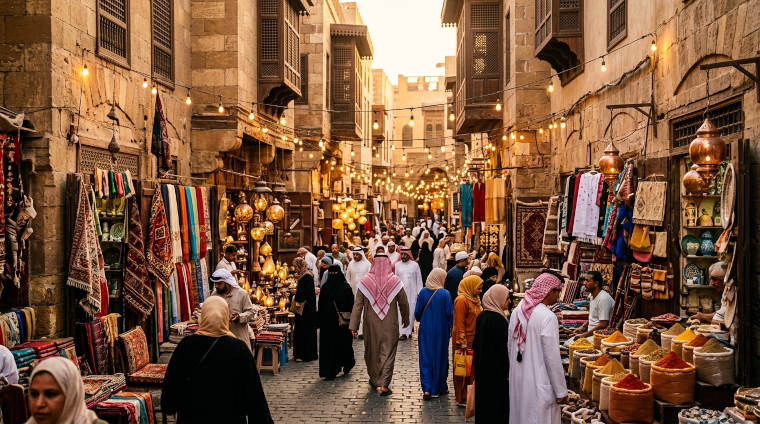
Souq Waqif is Doha's oldest market, retaining the atmosphere of an Arab bazaar with its wooden beams, narrow alleyways, and stalls selling spices, fabrics, incense, and souvenirs. It is easy to spend a couple of hours there, browsing shop windows filled with saffron, hand-woven rugs, and leather goods, before stopping to eat at one of the cafés serving traditional Qatari and Lebanese cuisine.
A separate section of the market is given over to the falcon souq — a place unique to this country and the whole region, where hunting birds can be seen in person.
Within a few minutes' walk begins the Corniche — a seven-kilometre pedestrian zone along the bay, with views of the West Bay skyline in Doha. The best time for a stroll through this part of the city is in the evening, around sunset, when the desert heat subsides and the buildings are illuminated with lights.
Allow 2–3 hours for the market and a further hour to an hour and a half for a leisurely walk along the waterfront. This part of Doha can be reached by taxi or by metro to Souq Waqif station; entry to the market and the waterfront is free, and the area is open virtually every day.
The Pearl-Qatar and the Msheireb district
The artificial island of Pearl-Qatar is a district of yacht marinas, Mediterranean-style waterfront promenades, and boutiques of international brands. The atmosphere there is quite different, more reminiscent of a European resort: restaurants with terraces by the water, luxury cars, and residential complexes in pastel shades.
A stroll around the marinas and the central Porto Arabia square takes 2–3 hours; it is worth setting aside extra time for dinner with a view of the yachts — this is one of the most atmospheric spots in Doha for an evening out.
The Msheireb district is the stylistic opposite of the island, yet no less architecturally interesting. It is a large-scale urban development project in Doha where contemporary buildings have been designed to incorporate traditional elements of Arab architecture: carved mashrabiya screens, interior courtyards, and natural ventilation typical of structures built in the midst of Qatar's desert.
It is worth wandering along the pedestrian streets, stepping into galleries, and visiting the small museums dedicated to the history of Qatar. An hour and a half to two hours is sufficient to explore this part of Doha; the most convenient way to get there is by metro; the station shares the same name, Msheireb.
Katara Cultural Village
The Katara Cultural Village complex is a large site encompassing an open-air amphitheatre, art galleries, a theatre, and concert halls that regularly host festivals, exhibitions, and performances.
The architectural style combines elements of traditional Arab construction — domes, arches, mosaic façades — with modern concert and exhibition spaces. The village also has beaches with clean sand and restaurants serving cuisine from around the world, making this part of Doha a convenient place to unwind after a full day of visiting museums.
The best time to visit this part of Qatar is in the evening, when the heat subsides, the architectural lighting comes on, and cultural events begin. Entry to most of the site is free; individual exhibitions and performances may be ticketed.
The most convenient way to get there is by taxi; the journey from the centre of the city takes 15–20 minutes. Allow 2–3 hours for a walk around the village and a visit to one or two galleries.
Attractions Outside Doha
If you have at least one free day remaining after exploring Doha, it is well worth venturing beyond the city. The attractions of Qatar are not confined to the capital; just one to two hours' drive from Doha lie the country's more remote sights, such as the boundless sands of the desert, the wild shores of the Arabian Gulf, and monuments that predate Qatar's oil boom by a very long time.
The contrast with the gleaming skyscrapers of West Bay is at its most stark there, and it is precisely for this reason that such trips into the country tend to linger in the memory longer than any museum.
The Inland Sea and desert safari
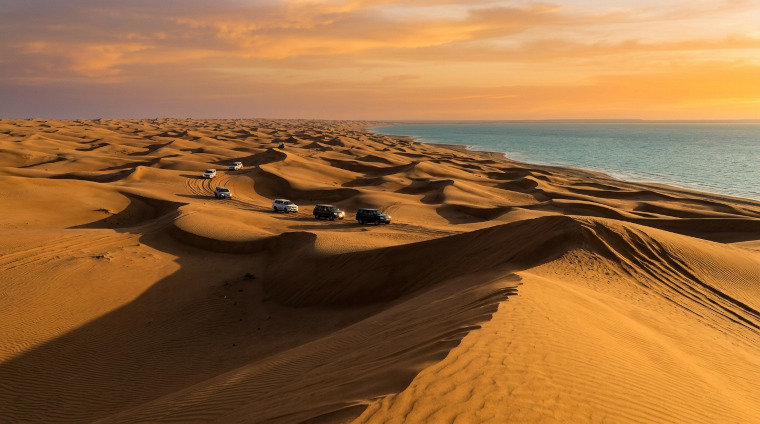
Khor Al Adaid, or the Inland Sea, is a natural phenomenon found almost nowhere else in the world: an inlet of the Arabian Gulf cuts deep into the desert and finds itself surrounded on all sides by towering sand dunes.
This place lies at the very south of Qatar, on the border with Saudi Arabia, approximately one and a half to two hours' drive from Doha. It is impossible to reach it on your own in an ordinary car, as a four-wheel-drive is essential, so most tourists book an organised desert safari with a local driver-guide.
The programme typically includes a jeep ride across the dunes, with steep descents and ascents, a stop at the Inland Sea for swimming and photographs, and watching the sunset amid the sands — a moment that draws many visitors to this spot even without the rest of the itinerary. Some tours also include an overnight stay in a camp with dinner, quad-biking, and sandboarding down the dunes.
The image was generated using AI technologies
What to bring to the desert:
sunglasses and a hat;
sunscreen with a high SPF;
a supply of water;
a light jacket — the desert cools quickly in the evening.
It is best to book a safari in advance through your hotel or a tour operator; a full day's excursion takes 6–8 hours.
Al Zubara Fort and the petroglyphs
For those who wish to understand Qatar's history more deeply, a trip to Al Zubara Fort is well worthwhile — it is one of Qatar's few UNESCO World Heritage sites.
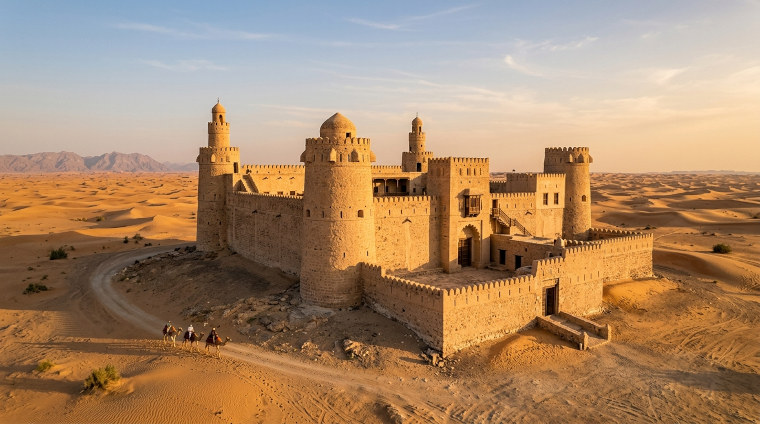
The fort stands on the north-western coast, approximately an hour's drive from Doha, and was once the centre of a prosperous trading town that thrived on pearl fishing and maritime trade. Today it is an open-air museum with reconstructed walls, towers, and a small exhibition inside.
Not far away lies another site — the Al Jassasiya petroglyphs, ancient rock carvings incised into limestone slabs in the middle of the desert. The depictions of boats, animals, and geometric patterns belong to various historical periods, and this is one of the few surviving monuments of the pre-Islamic era in the region.
The image was generated using AI technologies
Both sites can be reached by hire car; the roads are asphalted and in good condition. Allow about an hour and a half to explore the fort, and about half an hour to see the petroglyphs. The entire trip around Qatar shouldn’t take more than a single day.
Camel racing and falconry
Camel racing is one of the most spectacular national pastimes of the Qataris, preserved since Bedouin times. Today the camels are driven along the track not by jockeys but by robotic riders controlled by their owners from cars alongside the course.
The racecourse is located in the Al Shahaniya area, approximately 30–40 minutes' drive from the city; races take place mainly during Qatar's cooler season — from October to March, most often at weekends in the morning hours.
Falconry is another tradition deeply woven into the culture of Qatar: for local residents, a falcon is not simply a bird but a symbol of status and a connection to the country's Bedouin past. Falcons can be seen in person at the specialised market in Souq Waqif or at falconry demonstrations in the desert, which are frequently included in Qatar tour programmes.
An excellent souvenir would be falcon accessories and ornaments — leather hoods, bells, and perches decorated with traditional patterns; these are sold in the shops next to the bird market, and this spot deserves a dedicated stop on the itinerary.
If two or three days are available, it is ideal to combine a morning visit to the racecourse with an afternoon trip to Al Zubara Fort — both sites lie in the same direction from Qatar's capital, which makes planning a route around the city and its surroundings straightforward.
Practical Tips: Itineraries, Food, and Shopping
Getting around Doha is straightforward even for those visiting the country for the first time. Doha's metro is clean, modern, and inexpensive; three lines cover the key districts, including the airport, Souq Waqif, and West Bay, and a journey costs a couple of riyals. Taxis are also widely available and reasonably priced by tourist standards; a car is easy to order via an app or to find directly outside the hotel.
For families with children, the metro is particularly convenient: air-conditioned carriages provide relief from the heat, and stations are equipped with lifts. If a great deal of travel is planned, it is best to combine both options: the metro for longer journeys between districts, and taxis for specific trips and evening outings.
A one-day itinerary in Doha
If a layover at the airport stretches to 8–12 hours, there is ample time to explore and form an impression of the city. The morning is best devoted to museums and shopping centres, as it is cool inside, whilst the heat outside is still building. A visit to the National Museum or a stroll around one of the malls with breakfast make for an excellent start.
During the afternoon, as the heat becomes less intense towards evening, one can walk through the Msheireb district and appreciate the contrast between modern and traditional architecture. The evening calls for a visit to Souq Waqif: the atmosphere of an eastern bazaar, dinner at a local restaurant, and a leisurely walk along the Corniche with views of the illuminated skyscrapers.
Thanks to the FIFA World Cup, getting around the city has become noticeably easier: the expanded metro and upgraded roads allow this entire itinerary to be completed in a single day without rushing, with time to spare before returning to the airport.
Food and souvenirs
An introduction to Qatari cuisine is best begun with machboos — braised meat with rice and spices, a dish found on the menu of virtually every traditional restaurant.
Be sure to try karak tea — a strong tea with milk and spices — and for dessert, dates with cardamom, a classic Arab treat. For authentic cuisine, head to the restaurants of Souq Waqif or the individual eateries of the Cultural Village, which serve dishes unadapted to western palates.
What to buy as a souvenir:
dates in gift packaging;
local coffee with cardamom;
spices and incense;
hand-woven rugs;
gold and silver jewellery made by local craftsmen;
perfumes and oil fragrances sold by volume.
For atmosphere and the opportunity to haggle, Souq Waqif is the place to go — prices are more flexible there and a good discount can often be found. For guaranteed quality and fixed prices, head to the shopping centres such as Villaggio or Mall of Qatar; packaged dates and coffee, convenient for travelling, are also sold there.
The questions of what to see in Qatar and what to bring home as a memento are most logically addressed together, as almost all the major attractions are situated close to markets or malls, so shopping can easily be woven into the general route of a day's sightseeing.
Frequently Asked Questions
How many days are needed for sightseeing in Qatar?
Three to four days are sufficient for a first visit to Qatar. In that time it is perfectly feasible to see the main attractions of Doha and to venture out of the city for a desert safari or a trip to Al Zubara Fort. If you only have 8–12-hours, it is best to focus on a single district — Souq Waqif and the Corniche, for example, give a thorough introduction to the city.
For a more in-depth experience of Qatar's culture and architecture, a week is a better allowance, so that museums and the desert can both be enjoyed at a leisurely pace. The attractions of Qatar are clustered together, so even a short trip leaves a deep impression.
What is prohibited in Qatar?
In Qatar, the public consumption of alcohol outside hotels and licensed venues is forbidden, as are open displays of affection in public. Women in Qatar are advised to avoid bare shoulders and short skirts, especially near mosques and government buildings.
Photographing local residents without permission — especially women — is considered a serious breach of the etiquette observed in the country. Criticism of Qatar's ruling family, religion, and state policy in any form is also strictly prohibited.
Russian citizens do not need a visa to enter Qatar if the trip lasts up to 30 consecutive days. A valid international passport and a return ticket are sufficient; an entry stamp is placed in the passport directly at Qatar's airport upon crossing the border.
For a longer stay in Qatar, a visa must be obtained in advance through the Qatari consulate or online. Entry requirements for Qatar may change periodically, so it is worth checking the current conditions before travelling.
What to see in Qatar with children?
The National Museum of Qatar is an excellent choice for families with children — the multimedia halls and the unusual architecture in the shape of a desert rose captivate even young travellers. The Katara Cultural Village offers beaches, parks, and open spaces where children can simply run around after a day of museums.
A trip to the camel races or a falconry display, which are popular in Qatar, makes for a memorable outing; live experiences stay with children far longer than any photographs. Doha's metro, with its air-conditioned carriages and lifts, makes travelling around the city with children comfortable even in the heat, which visitors to Qatar during the summer season particularly appreciate.
Article header image was generated using AI technologies
Visa-free entry rules for Russian citizens. Documents for entering Jordan without a visa. When a visa is still required for visiting Jordan. Transit, flights and health insurance. Tourist sites and em...
General information about Dubai Airport terminals. A detailed description of each terminal. Business lounges and waiting areas. Navigation between terminals and transport. Practical information and se...
At first glance, schools in Dubai differ little from those in other countries: similar large buildings, classrooms, and uniforms. However, the education process itself is structured slightly different...
Salalah: location and when to visit. How to get to and where to stay in Salalah? What to see and do in Salalah? What to eat and what to bring back from Salalah? Tips for tourists: safety and rules of ...
The official language of the United Arab Emirates. English language in the United Arab Emirates. Useful Arabic phrases for communication in the UAE. Frequently asked questions about the language of th...
What DEWA Dubai is and what services it provides. How to connect DEWA services: a step-by-step guide. DEWA tariffs and the payment calculation system. Methods for paying DEWA bills. Energy-saving prog...
Smoking laws in Dubai and the UAE. Where you can smoke in Dubai. E-cigarettes and vapes in Dubai. Rules on importing tobacco products. Practical advice for smokers. Frequently asked questions.
Does voice communication via messengers work in the UAE? Main telecommunication operators in the UAE. 3 telecommunication operators in the UAE with eSIM support. How to activate an eSIM for communicat...
Description of Al Sufouh. Geography and attractions of Al Sufouh. Infrastructure of Al Sufouh. Real estate and investment appeal of Al Sufouh. Frequently Asked Questions about Al Sufouh.



 The image was generated using AI technologies

 The image was generated using AI technologies


 The image was generated using AI technologies
 The image was generated using AI technologies