Home/Middle East/Qatar population: size, composition, and demographic characteristics of the country
19.08.2026
Middle East
1220
Reading time: 13 minutes
Qatar population: size, composition, and demographic characteristics of the country
Save the article:
Why is Qatar's population considered one of the most unusual in the world? This small Middle Eastern state holds a leading position in terms of the proportion of foreign nationals among all the countries of the Persian Gulf, and its demographic structure differs fundamentally from that of most countries on the planet.
Qatar's population is a unique example, with indigenous residents constituting an absolute minority on their own territory, whilst the majority of residents consists of migrant workers from Asia and other regions. This situation is directly linked to the country's rapid economic growth, which began with the extraction of hydrocarbons, and warrants separate, detailed study.
What will you gain from reading this material? This article examines the precise population figures, the ratio of Qataris to expatriates, growth trends over recent decades, and the reasons behind such an unusual demographic imbalance.
We will show the connection between the composition of the population and the country's economic indicators, compare the situation with neighbouring Persian Gulf states, and explain complex concepts in simple language with concrete figures and up-to-date statistics.
General Characteristics of Qatar's Population
To understand why Qatar's demographic structure is considered one of the most atypical in the world, it is worth first looking at a map of the region and assessing the conditions in which this picture took shape.
The country's small territory, arid climate, and rapid urbanisation have created a unique combination of factors that have directly influenced where and how people live in this Persian Gulf state. News of the country's development frequently features in reviews by international analysts.
Geographical position and territory
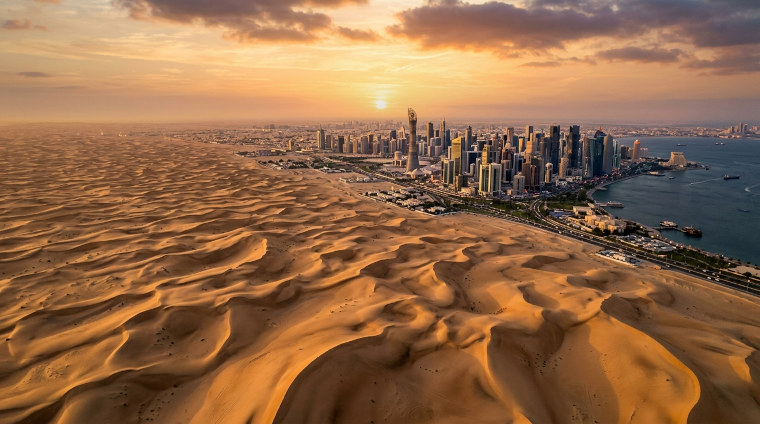
Qatar is a state situated on the peninsula of the same name, which extends into the waters of the Persian Gulf on the eastern side of the Arabian Peninsula. The country's only land border runs with Saudi Arabia to the south, whilst all other sides are washed by the waters of the gulf, which makes Qatar almost island-like in terms of its geographical position.
The total area of the territory amounts to just over 11,500 square kilometres, which is smaller than the territory of many regions in neighbouring countries.
The country's terrain consists predominantly of desert and semi-desert landscapes with sparse oases and low-lying elevations. Such natural conditions have historically limited the possibilities for settlement, which is why the majority of Qatar's residents are concentrated along the coast, where the climate is milder and access to the sea provides trading and logistical advantages.
The image was generated using AI technologies
The inland desert areas remain virtually uninhabited, creating a stark contrast between the densely built-up coastal cities and the almost deserted interior of the peninsula.
Current population size
According to data from international statistical organisations, including the UN and analytical platforms such as Trading Economics, the population of Qatar in 2024 was estimated at around 3.05 million people. For comparison, in the early 2000s the number of residents in Qatar did not exceed 600,000–700,000; such growth occurred in less than two decades and is linked primarily to the influx of migrant workers.
Trends in recent years show a relative stabilisation: whereas during the period of active preparation for major international projects the population was growing by 5–8% annually, growth rates in recent years have slowed and are estimated, depending on the source, at approximately 1.8–2.4% per year.
Analysts forecast that by 2030 the population of Qatar could reach 3.3–3.5 million, provided the current economic policy and demand for labour are maintained. The state's economic policy directly shapes these trends.
The image was generated using AI technologies
It is important to understand that demographic indicators are dynamic and largely dependent on the state of the labour market, since the overwhelming majority of population growth is driven not by the birth rate but by migration. This makes the country's demographic statistics closely tied to economic cycles, rather than to natural processes alone.
Population density and urbanisation
Despite its small overall territory, the population density of Qatar exceeds 200 people per square kilometre; however, this figure is distributed extremely unevenly. Qatar has a very high level of urbanisation: the overwhelming majority of the population lives in cities, mostly in the Doha area, which makes Qatar's urbanisation rate one of the highest in the world.
This concentration is explained by the location of business districts, ports, and infrastructure along the coastal zone, whilst the inland desert territories remain virtually uninhabited. This contrast between the compact territory and high urban density is one of the key characteristics to bear in mind when studying the country's demography.
Demographic Structure and Indigenous Population
In seeking to understand who Qataris are and why there are so few of them relative to the country's total population, it is important to recognise that Qatar's demographic structure is the result of deliberate economic policy rather than a coincidental set of circumstances.
Qatar's indigenous population today constitutes a small but privileged group of citizens, around which the entire system of labour migration has been built — a system that ensures the functioning of one of the wealthiest countries in the world.
The ratio of citizens to migrant workers
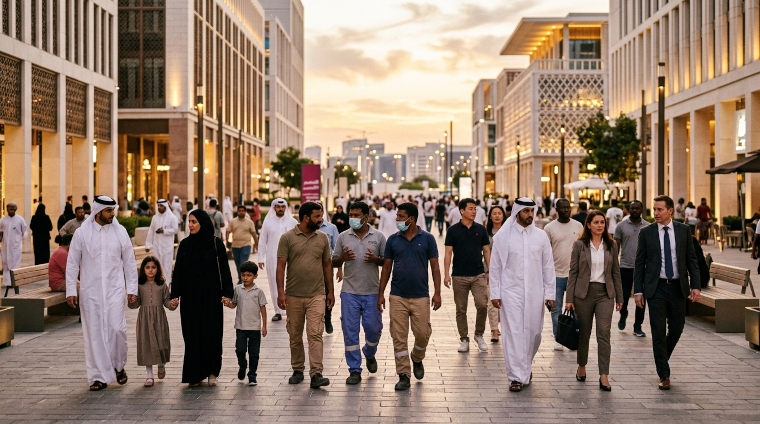
According to current estimates, indigenous Qataris account for only a small share of the country's population; various estimates put this at around 10–12% of residents, which is approximately 300,000–370,000 people out of more than 3 million. The remaining 88–90% are foreign workers and their families, who have come to the country in search of employment.
This disproportion did not emerge overnight: before the discovery of oil and gas deposits in the mid-twentieth century, Qatar was a poor territory with a small number of residents engaged in fishing and pearl diving.
The rapid growth of hydrocarbon extraction in the 1970s–1990s required enormous quantities of labour for the construction of infrastructure, ports, and roads, and later for facilities connected with large-scale international projects.
The small indigenous population lacked sufficient labour resources, so the authorities opted for the mass recruitment of foreign specialists and workers. As a result, an economy took shape in which local residents are engaged primarily in the public sector and in management, whilst the private sector, construction, and the service industry are sustained almost entirely by the labour of expatriates.
National composition and religion
Qatar's national composition is extremely diverse and reflects the geography of labour migration from across Asia and the Arab world. The largest diasporas are formed by people from India, Nepal, Bangladesh, the Philippines, Pakistan, and Sri Lanka; people from these countries are employed in construction, services, and logistics.
A significant proportion is also made up of Egyptians, Jordanians, Syrians, and representatives of other Arab countries, many of whom work in education, healthcare, and public administration owing to their linguistic and cultural affinity.
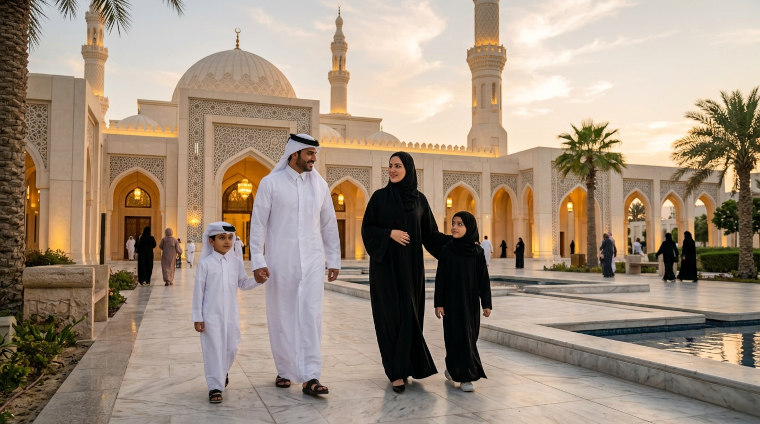
The state religion of the country is Islam, and the overwhelming majority of native Qataris practise the Sunni branch. At the same time, among the migrant population there are representatives of Hinduism, Christianity, Buddhism, and other faiths, which makes the religious composition of foreign residents considerably more diverse than that of citizens.
The image was generated using AI technologies
The ruling Al Thani dynasty has traditionally served as the custodian of the country's Islamic identity: under Emir Hamad bin Khalifa Al Thani, and subsequently under his successors, Islam retains its status as the fundamental basis of legislation and public life, despite the growing proportion of foreign nationals of other faiths.
Age structure of the population
Qatar's age pyramid looks atypical compared with most countries in the world. The majority of residents — over 75–80% — are people of working age between 25 and 54, which is directly linked to the influx of migrants who come to the country specifically for work.
The proportion of children and adolescents is significantly below the global average, and the proportion of elderly people over the age of 65 is minimal, since foreign workers typically return to their home countries upon completion of their employment contracts or at retirement age.
Another striking characteristic is a pronounced gender imbalance: men account for around 70–75% of all residents, whilst women make up only 25–30%, which is explained by the predominance of male labour in construction and heavy industry.
This structure makes Qatar a convenient labour market for employers, but at the same time creates social and cultural characteristics that are important to bear in mind for anyone planning to relocate to the country or studying its demography for analytical purposes.
Population Growth and Migration
Qatar's population growth is one of the most striking illustrations of how an economy can fundamentally transform the demographic map of an entire country.
In less than seven decades, a small fishing community on the shores of the Persian Gulf has been transformed into a state with one of the highest GDP per capita figures in the world, and the number of residents has grown many times over. To understand the logic behind these changes, it is worth tracing the country's path from the early twentieth century to the present day.
Historical population growth
In the early and mid-twentieth century, no more than 25,000–30,000 people lived on the territory of modern-day Qatar — the local population was engaged in fishing, pearl diving, and trade.
The situation began to change after the end of the Second World War, when oil exploration began in the region, and in 1971 Qatar gained independence from Great Britain. By that point, the country's population had grown to 100,000–150,000 owing to the first waves of migrant workers who had arrived to service the oil extraction industry.
The real demographic leap occurred in the 2000s–2010s, during the period of economic boom linked to rising hydrocarbon prices and large-scale infrastructure modernisation. In 2000 Qatar's population stood at around 600,000, and by 2010 it had grown manifold, primarily through migration; by 2020 it had reached 2.8 million.
Such a rate of growth is rare in world history and is explained not by an increase in the birth rate but by the large-scale recruitment of foreign labour year after year.
Causes of the migration influx
The primary driver of population growth is the economic incentives that Qatar offers to foreign workers. The absence of income tax, competitive wages compared with migrants' countries of origin, and stable demand for labour in construction, the service sector, and transport attract millions of workers from South and South-East Asia.
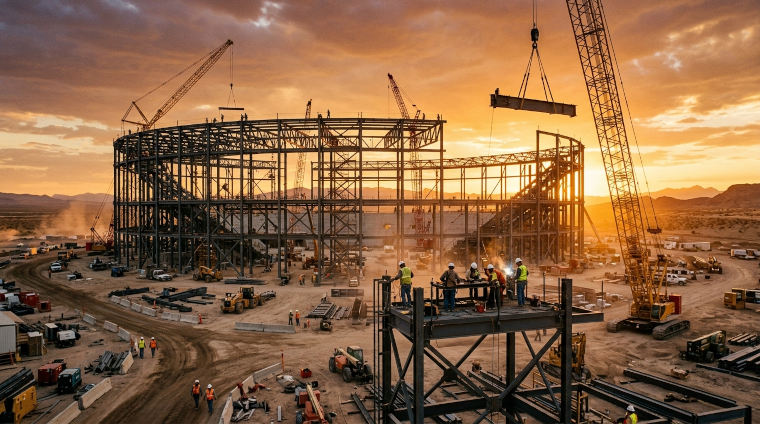
A particularly important role in shaping migration flows was played by the preparations for the 2022 FIFA World Cup: the construction of stadiums, hotels, transport infrastructure, and entire urban districts required the recruitment of hundreds of thousands of additional workers over the course of one decade.
The image was generated using AI technologies
The labour markets of India, Nepal, Bangladesh, and the Philippines have traditionally been the main sources of labour for the construction sector, whilst specialists from Arab countries and Europe more often occupy positions in management, education, and healthcare.
This structure of demand explains why population growth in Qatar is markedly undulating: it accelerates during years of active construction and slows down when major projects are completed.
After 2022, the rate of growth slowed noticeably, as a portion of temporary workers left the country upon the completion of their contracts, and the authorities began to revise their policy on recruiting foreign labour in favour of more highly qualified specialists needed for the continued development of the economy beyond the construction sector.
Thus, Qatar's demographic history over the past decades, up to and including the 2020s, demonstrates a direct dependence between economic cycles and population size, which makes it far more pronounced than in most other countries in the world.
Qatar's Economy and Its Influence on the Population
Qatar's economy is the foundation upon which the country's entire demographic structure rests. It is the revenues from hydrocarbon sales that determine how many foreign workers come to the country, what standard of living native residents enjoy, and why the population structure continues to be so atypical.
To understand the logic of the demographic processes examined in the preceding sections, it is important to understand how Qatar's budget is formed and how these funds are distributed between citizens and visiting workers.
GDP per capita and standard of living
Qatar's GDP per capita is one of the highest in the world; according to data from the International Monetary Fund and the World Bank for 2023–2024, this figure stands at around 80,000–85,000 US dollars at purchasing power parity.
Qatar consistently ranks among countries with a very high GDP per capita, although its precise position depends on the calculation methodology and the year in question, competing with Luxembourg, Singapore, and Ireland. It is important to understand, however, that this is an average figure and does not reflect the actual distribution of income between citizens and migrant workers.
The bulk of state revenues and social benefits go to the indigenous population: Qatari citizens have access to free education, quality healthcare, housing subsidies, and high salaries in the public sector. This is precisely why Qatar ranks among the wealthiest countries in the world not only in terms of formal statistics but also in terms of the actual standard of living of its citizens.
Migrant workers, who make up the overwhelming majority of the population, earn incomes significantly below the average GDP per capita figure, which creates a noticeable degree of social stratification within the country. Nevertheless, even the wages of ordinary foreign workers often exceed what they could earn at home, which continues to stimulate the migration flow.
The role of oil and gas in the economy
The basis of Qatar's economy remains the extraction and export of hydrocarbons. The country possesses some of the world's largest reserves of natural gas, concentrated predominantly in the giant North Field, which Qatar shares with Iran.
The image was generated using AI technologies
Thanks to these natural gas reserves, the state has become the world's largest exporter of liquefied natural gas, supplying LNG to Asia, Europe, and other regions. Oil extraction also makes a substantial contribution to the budget, although its share in the export structure has gradually declined over recent decades in favour of the gas sector.
Revenues from hydrocarbon sales finance virtually every sphere of life in the country: the construction of infrastructure, the development of education and healthcare, and the large-scale sovereign wealth funds that Qatar uses for economic diversification.
It is the oil and gas sector that generates the main demand for foreign labour, from engineers and technical specialists from Europe and the United States to construction workers from South Asia employed in building LNG plants, ports, and pipelines. Without the influx of expatriates, such rates of extraction and export would simply be impossible given the country's small indigenous population.
The influence of the raw-materials sector extends far beyond direct employment: revenues from gas and oil exports enable the state to maintain low taxes, subsidise utility services, and create attractive conditions for business, which further strengthens Qatar's appeal to migrants.
In this way, the country's economy and its demographic structure form a closed cycle: natural resources generate wealth, wealth attracts labour, and labour in turn ensures the extraction and processing of those same resources.
Comparison of Qatar with Other Countries in the Region
In order to properly appreciate the scale of the demographic phenomenon, Qatar should be considered not in isolation but in the context of the entire Persian Gulf region.
The neighbouring monarchies — Saudi Arabia, Bahrain, Kuwait, Oman, and the UAE — have over recent decades undergone a similar transformation from agrarian and fishing societies to wealthy oil-and-gas economies, whilst at the same time displaying markedly different proportions between citizens and foreigners, different patterns of settlement density, and different income levels.
Qatar among the Persian Gulf states
Among the Persian Gulf states, Qatar stands out for its combination of small territory and an exceptionally high concentration of foreign labour. Saudi Arabia is the largest country in the region, with a population exceeding 36 million; however, the proportion of migrants there is around 40%, which is notably lower than Qatar's 88–90%.
Kuwait is closest to Qatar in terms of demographic structure: expatriates account for approximately 70% of residents, with a total population of around 4.3 million. In Bahrain, with a population of roughly 1.5 million, the proportion of foreigners exceeds 50%, and the population density is one of the highest in the world due to the modest size of the island state.
Oman presents a more balanced picture: native Omanis account for approximately 58% of the country's population, making it an exception among its neighbours. Although Qatar occupies a modest position in terms of absolute population size, it ranks among the leaders in the region by income per capita.
Qatar's position in global rankings
In the global context, Qatar occupies prominent positions across several areas simultaneously. According to United Nations data, the country consistently ranks among the states with the highest proportion of migrants in their overall population structure — a figure that places it on a par with the UAE and ahead of the vast majority of countries in the world.
In terms of GDP per capita, Qatar consistently features in the top ten of global rankings, competing with Luxembourg, Singapore, and Ireland, whilst in terms of absolute population size the country occupies only around 140th place among the world's states; by global standards Qatar appears modest, but economically the country cuts a very different figure.
The population density indicator is above the global average for Qatar, but is distributed extremely unevenly due to the concentration of residents around Doha.
The 2022 FIFA World Cup made a significant contribution to strengthening the country's international standing; hosting a tournament of that scale attracted the attention of investors, tourists, and business partners, and the infrastructural legacy continues to benefit the economy years after the final match.
Several years before the tournament began, the country's authorities had been consistently preparing the economy for an influx of visitors, and already in the first years after the tournament it became clear that the resources invested were paying off.
For those new to the subject, a useful analogy to keep in mind is this: Qatar is a compact but extraordinarily efficient economic mechanism, in which every resident year after year generates far more added value than in the majority of countries with more numerous populations.
Frequently Asked Questions
How many people live in Qatar at present?
According to the most recent data, approximately 3.19 million people live in Qatar, as confirmed by UN statistics and analytical platforms such as Trading Economics. Qatar continues to show growth in its number of residents, although the rate of growth has slowed noticeably compared with the period of active preparations for the FIFA World Cup.
For comparison, in the early 2000s the number of residents in the country did not exceed 600,000–700,000. Such a sharp increase over two decades makes Qatar one of the most dynamically growing states in the world by this indicator.
The primary reason is the economic incentives that the state has created through revenues from oil and natural gas extraction. The absence of income tax, high wages relative to countries of origin, and stable demand for labour in construction, the service sector, and transport attract millions of workers from South and South-East Asia.
The growth in Qatar's population is directly linked to large-scale infrastructure projects, including preparations for international sporting events. The small indigenous population was objectively unable to supply the required volumes of labour, and so reliance was placed on foreign workers.
What proportion of native Qataris live in the country?
Native residents of Qatar account for only around 10–12% of the total number of people living in the country, that is approximately 300,000–370,000 people out of more than 3 million residents. The remaining 88–90% are migrant workers and their families, who have come predominantly from India, Nepal, Bangladesh, the Philippines, and other Asian countries.
This proportion makes Qatar one of the world leaders in terms of the share of foreign nationals in the overall population structure. It is citizens of the country who receive the social benefits and hold key positions in the public sector.
What is the official language of Qatar?
The official language of Qatar is Arabic, which is spoken by the indigenous population and used in government institutions, education, and administration. Given the high proportion of foreign nationals, English effectively functions as a second working language in business, trade, and the service sector.
Among migrants, Hindi, Urdu, Filipino, and other South Asian languages are widely spoken depending on the country of origin. This linguistic diversity reflects the multinational composition of residents and makes Qatar a convenient hub for international business.
Article header image was generated using AI technologies
Does voice communication via messengers work in the UAE? Main telecommunication operators in the UAE. 3 telecommunication operators in the UAE with eSIM support. How to activate an eSIM for communicat...
Where Ajman is located. Ajman's infrastructure. What to see and do in Ajman. Where to eat and what to try in Ajman. Ajman's economy. 3 reasons to invest in Ajman. Best areas of Ajman. Well-known prope...
Main attractions of Dubai. Entertainment for families with children. Evening entertainment and nightlife. Free and budget-friendly entertainment. Practical information for tourists. Frequently asked q...
History and origins of Arabian mythology. Gods of Arabian mythology and the ancient pantheon. Djinn and spirits in Arabian mythology. Mythical creatures of Arabian mythology. The influence of Arabian ...
Why Arabic is not a single language. How Arabic dialects arose — a brief history. The main groups of Arabic dialects — where they are spoken and how. Do Arabs from different countries understand one a...
Description of the Al Quoz district in Dubai. Location of the Al Quoz district. Infrastructure of the Al Quoz district. Leisure and entertainment in Al Quoz. Specifics of the real estate market in Al ...
What is a UAE resident? Types of visas for UAE residents. Benefits of UAE resident status. Frequently asked questions about obtaining UAE residency status.
General situation regarding safety in the UAE for tourists. Safety of women in the UAE. Rules of conduct for tourists in the UAE. How safe is public transport in the UAE for tourists? What is prohibit...



 The image was generated using AI technologies
 The image was generated using AI technologies

 The image was generated using AI technologies

 The image was generated using AI technologies

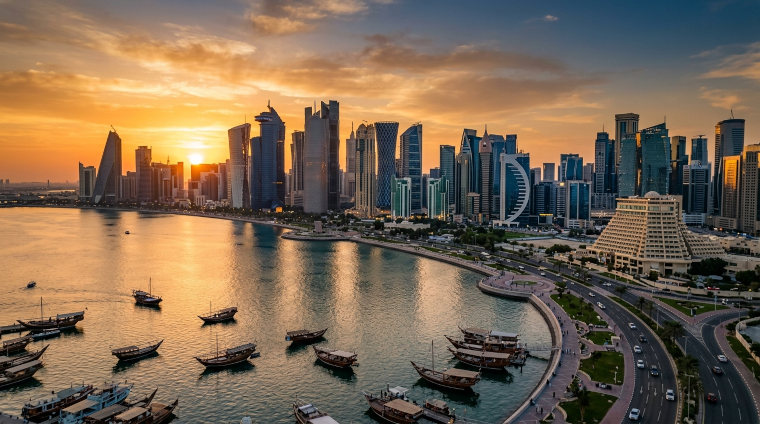 The image was generated using AI technologies